The Crew Dragon Endeavour spacecraft during its descent (Image NASA TV)

A few hours ago, SpaceX’s Crew Dragon Endeavour spacecraft concluded its Crew-6, or SpaceX Crew-6, mission for NASA by landing without problems. On board were astronauts Sultan Alneyadi, Woody Hoburg, and Stephen Bowen and cosmonaut Andrey Fedyaev, who had reached the International Space Station on March 3, 2023, and were part of Expedition 68/69. The four of them finished the sixth regular crewed mission of SpaceX in the Atlantic Ocean, off the coast east of Jacksonville, Florida. The Crew Dragon departed the Station about seventeen hours earlier.

The Aditya-L1 space probe at blastoff (Image courtesy ISRO)

A few hours ago, the Indian space probe Aditya-L1 blasted off from the Satish Dhawan space center atop a PSLV-XL rocket. After about ten minutes, it regularly separated from the rocket’s last stage. In about 109 days, Aditya-L1 will reach the Lagrange point called L1, about 1.5 million kilometers from the Earth, where it will begin its mission of observing the solar atmosphere and various processes taking place on the Sun’s surface. It will join other space probes and solar observatories helping to unlock the last secrets of the Sun.

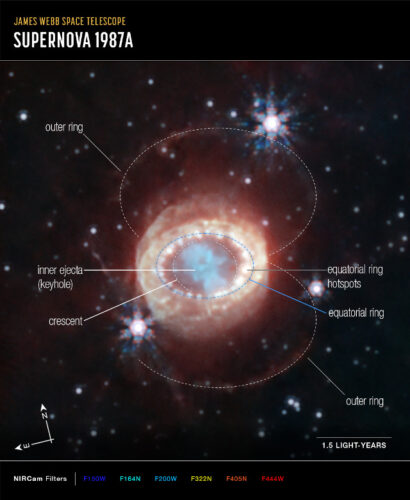
SN 1987A as seen by the James Webb Space Telescope's NIRCam (Near-Infrared Camera) instrument

An image of the remnants of supernova 1987A (SN 1987A) captured by the James Webb Space Telescope caught new details and never-before-seen structures such as the central one, which has a shape like a keyhole, and near it crescent-shaped formations. The NIRCam instrument proves again that it can see where other instruments have seen little or nothing in the decades since the supernova was detected. The aim is always to understand what happens in the years following a supernova to what remains of the star that exploded and to the materials ejected into interstellar space.

International Gemini Observatory/NOIRLab/NSF/AURA/P. Marenfeld QuasarPōniuāena

An article published in “The Astrophysical Journal Letters” reports the discovery of the most distant cold molecular gas in the interstellar medium of the galaxy that hosts the quasar nicknamed Pōniuāʻena, one of the three most distant bright quasars known. A team of researchers led by some associates of the Italian National Institute of Astrophysics (INAF) used observations conducted with the NOEMA (Northern Extended Millimeter Array) radio telescope to obtain the detection of the gas, to be precise carbon monoxide. This study can provide valuable information to understand how a supermassive black hole could have a mass 1.5 billion times the Sun’s when the universe was “only” 700 million years old.

The Crew Dragon Endurance spacecraft approaching the International Space Station in its Crew-7 mission (Image NASA TV)

A little while ago, SpaceX’s Crew Dragon Endurance spacecraft docked with the Harmony module of the International Space Station completing the first part of its Crew-7 or SpaceX Crew-7 mission that began with its launch almost 30 hours earlier. After checking that the pressure gets properly balanced, the hatch will be opened to allow Jasmin Moghbeli, Andreas Mogensen, Satoshi Furukawa, and Konstantin Borisov to enter the Station and start their mission, which will last about six months.