SpaceX's Crew Dragon Endurance spacecraft blasting off atop a Falcon 9 rocket in its Crew-7 mission (Image NASA TV)

A little while ago, SpaceX’s Crew Dragon Endurance spacecraft blasted off atop a Falcon 9 rocket from the Kennedy Space Center in its Crew-7 or SpaceX Crew-7 mission. After almost exactly twelve minutes, it successfully separated from the rocket’s last stage and went en route to carry out its mission. This is the 7th crewed mission of the Crew Dragon spacecraft within the normal rotation of the International Space Station crew. This is also the third mission for the Endurance. The launch takes place a day late because it took longer than expected to check the status of some valves of the life support system carried out after some of those of another Crew Dragon started corroding.

The Progress MS-24 cargo spacecraft approaching the International Space Station (Image NASA TV)

A few hours ago, the Progress MS-24 spacecraft docked with the International Space Station in the mission also referred to as Progress 85 or 85P. The Russian cargo spacecraft, which blasted off last Wednesday, August 24, Russian time, carries food, water, scientific experiments, fuel, and various hardware. Yesterday, the Station performed a maneuver using the Zvezda module’s engines to move from away the trajectory of a space debris but that had no consequences on the arrival of the Progress MS-24.

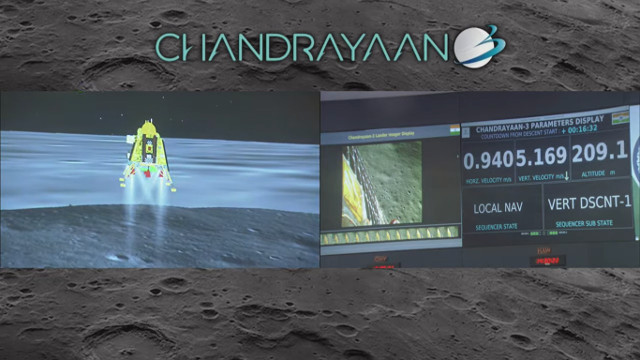
Animation of the Vikram lander and the Pragyan rover during the moon landing (on the left) and the real situation (on the right) (Image courtesy ISRO)

The Vikram lander and the Pragyan rover of the Indian mission Chandrayaan 3, launched on July 14, have successfully landed on the Moon. The idea at the Indian space agency ISRO was to replicate what was done almost exactly four years ago in the Chandrayaan 2 mission, eliminating the problems encountered on that occasion in order to achieve success. The hard lesson was learned and this time, the vehicles successfully completed the insidious maneuver of landing on the Moon. India joins the small club of nations that successfully sent a vehicle to the Moon.

The Progress MS-24 cargo spacecraft blasting off (Image NASA TV)

A few hours ago, the Progress MS-24 spacecraft blasted off atop a Soyuz-2.1a rocket from the Baikonur Cosmodrome in Kazakhstan. After about nine minutes it successfully separated from the rocket’s last stage and was placed on its route. The cargo spacecraft began its resupply mission to the International Space Station also called Progress 85 or 85P. In this mission, the route used is the one that requires about two days.

The Ring Nebula as seen by MIRI (Image ESA/Webb, NASA, CSA, M. Barlow, N. Cox, R. Wesson)

Just a couple of weeks after the publication of an image of the Ring Nebula, one of the most iconic planetary nebulae, captured by the James Webb Space Telescope’s NIRCam instrument, another image arrived, this time, captured by the MIRI instrument. Several filters were used to capture the emissions at various wavelengths in the mid-infrared to offer details that complement those offered by the NIRCam. The new details also indicate the presence of various compounds and about ten concentric arcs just beyond the outer edge of the main ring. These new results offer new insights into the processes taking place in the last stages of a star’s life and, in this case, the interaction with a possible companion.