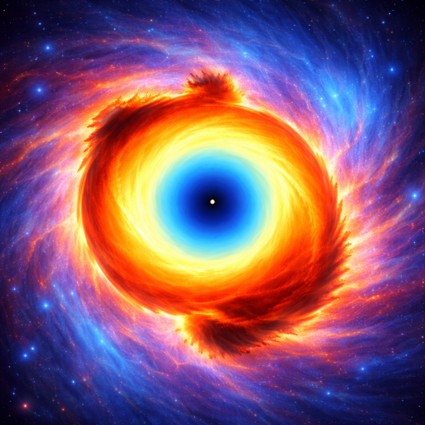
Artist's concept of the of the exoplanet PSR J2322-2650b and its pulsar (Image NASA, ESA, CSA, Ralf Crawford (STScI))

An article published in The Astrophysical Journal Letters reports the results of a study of a gas giant exoplanet cataloged as PSR J2322-2650b, which has a completely abnormal atmosphere composed above all of helium and carbon. A team of researchers used observations conducted with the James Webb Space Telescope to study the atmosphere of this exoplanet, which has a mass similar to Jupiter’s and has a distance from its star that is only one-hundredth of the Earth’s distance from the Sun. The star is a pulsar, adding another unusual element to the system. PSR J2322-2650b can’t be explained by current models of planetary formation.

The capsule of the Soyuz MS-27 spacecraft after landing (Image NASA+)

A few hours ago, cosmonauts Sergey Ryzhikov and Alexey Zubritsky and astronaut Jonny Kim returned to Earth on the Soyuz MS-27 spacecraft, which landed in Kazakhstan. They had reached the International Space Station on April 8, 2025, as part of a normal crew rotation. The capsule landed on its side, an event that can occur due to reentry conditions, but the crew members suffered no injuries.

The Zhuque-3 Y1 rocket blasting off (Photo courtesy LandSpace)

A few hours ago, the Chinese Zhuque-3 Y1 rocket blasted off from the Dongfeng commercial space innovation pilot zone, carrying a mass simulator consisting of a prototype of the Haolong cargo spacecraft, currently under development. The second stage successfully reached orbit with payload separation, achieving a successful primary mission upon its debut. LandSpace, the company that developed the rocket, aimed to land the first stage, but this failed due to an anomaly during the reenter maneuvers.

The crew of the Soyuz MS-28 spacecraft: Chris Williams, Sergey Kud-Sverchkov, and Sergey Mikaev (Photo courtesy of GCTC)

A few hours ago, the Soyuz MS-28 spacecraft was launched from the Baikonur Cosmodrome in Kazakhstan and, after a little more than three hours, reached the International Space Station with three new crew members on board. It docked with the Station’s Rassvet module. The ultra-fast track was used, which halves the journey duration and is used whenever the Station’s position makes it possible.

The Shenzhou 22 spacecraft blasting off atop a Long March-2F rocket (Photo courtesy Li Minggang/Xinhua)

Confirmation has arrived that the Shenzhou 22 spacecraft has reached the Tiangong space station with an automated docking maneuver. It launched with no crew aboard about 3.5 hours earlier atop a Long March-2F rocket from the Jiuquan Satellite Launch Center. The Shenzhou 22 was sent to the Tiangong to provide the Shenzhou 21 mission crew with a reliable vehicle to return to Earth.