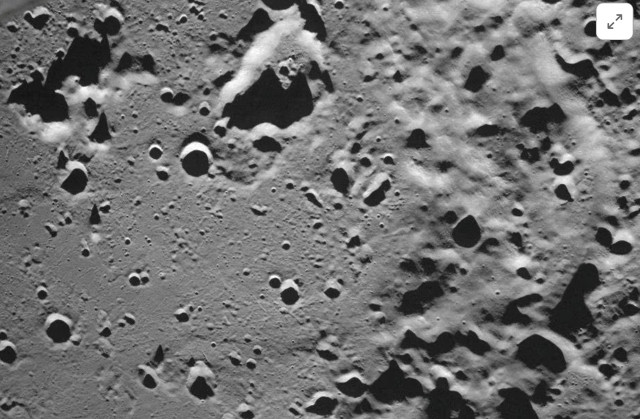
Photo of the Moon surface taken by the Luna 25 lander (Photo courtesy Roscosmos)

The Russian space agency Roscosmos has confirmed that its Luna 25 lander crashed on the Moon following an anomaly in one of the maneuvers that was supposed to lead to its Moon landing on Monday. The problems began on Saturday, when there was the problem and communications were lost. An examination of the telemetry data received up to that point led to the conclusion that the impulse was excessive, leading to a trajectory that caused a crash. Yet another problem in the Russian space program will bring consequences yet to be assessed in the Luna-Glob program which is based on increasingly ambitious missions for the next few years and had already accumulated years of delay.

Artist's concept of the HD 45166 system with the helium star in the foreground (Image ESO/L. Calçada)

An article published in the journal “Science” reports a study that identifies one of the stars in the binary system HD 45166 as the likely precursor of a magnetar. A team of researchers led by Tomer Shenar of the University of Amsterdam used various telescopes to study a so-called helium star, a massive star that is nearing the end of its life and has already ejected its outer layers and is left with a core formed by helium on its surface. This star revealed an extremely powerful magnetic field, estimated to be about 100,000 times the Earth’s.

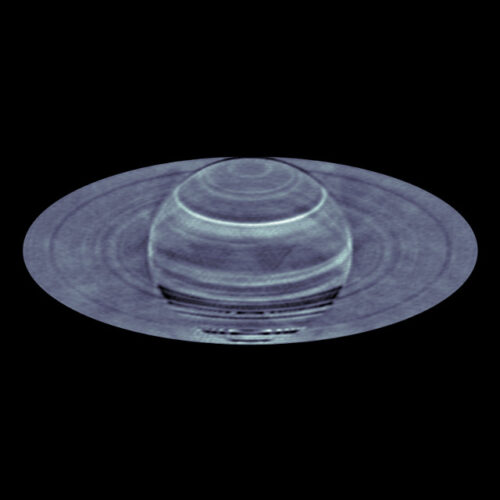
Saturn seen on radio waves from the VLA (Image S. Dvello (NRAO/AUI/NSF), I. de Pater et al (Berkeley))

An article published in the journal “Science Advances” reports a study on the megastorms active on the planet Saturn. A team of researchers used observations conducted with the VLA (Very Large Array) that allowed them to map the radio emissions coming from under Saturn’s surface and find anomalies in the distribution of ammonia gas. The conclusions of the study are that megastorms can last even a century and leave consequences that persist in the atmosphere even longer. This also shows differences from the giant storms existing on Jupiter.

On the left, the galaxy cluster WHL0137-08 and in the inset, the galaxy nicknamed the Sunrise Arc in its distorted form, which hosts the star Earendel

Two articles, one published in “The Astrophysical Journal” and one in “The Astrophysical Journal Letters”, report various aspects of a study of Earendel, the most distant single known star. Two teams of researchers with several members in common used observations conducted with the James Webb Space Telescope to obtain new details of this star, which even such a powerful instrument could only detect thanks to a gravitational lens. Officially cataloged as WHL0137-LS, the new study turns out to be a class B blue giant, much more massive than the Sun. Webb’s observations also reveal a luminous component that could belong to a less massive companion and not even the Hubble Space Telescope was able to detect.

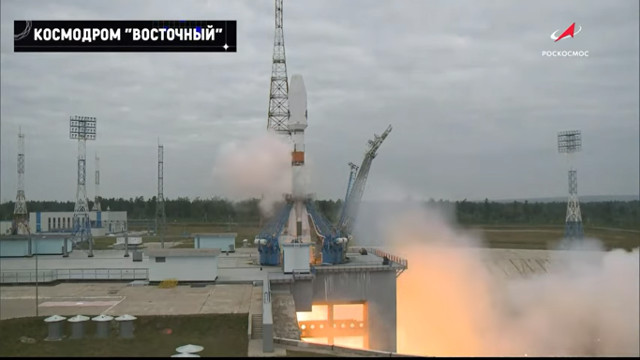
The Luna 25 lander blasting off atop a Soyuz-2.1b (Image courtesy Roscosmos)

A few hours ago, the Luna 25 lander blasted off atop a Soyuz-2.1b rocket from the Russian Vostochny Cosmodrome. After about an hour, the Fregat-M last stage pushed the vehicle to leave Earth orbit, performing the maneuver called in jargon TLI (Tras Lunar Injection) which will take it towards the Moon, where it will land near the south pole, near the Boguslavsky crater.

The Luna 25 mission is the first of the Luna-Glob program, which began in the 1990s with the ambition to reprise the Soviet Luna program and develop it in a way that wasn’t possible in the 1970s. For this reason, the name is Luna 25, considering it the follow-up mission to the 1976 Luna 24.