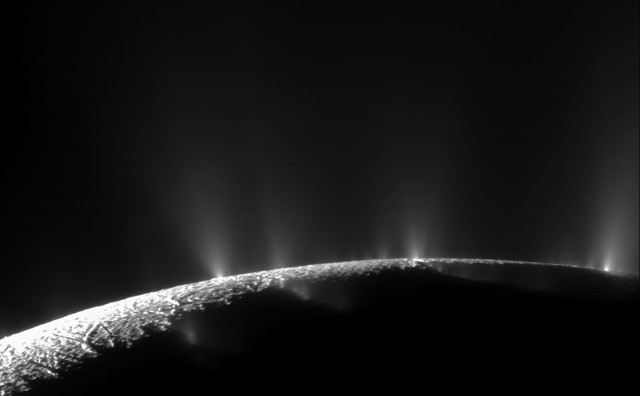
Enceladus and some of its geysers (Image NASA/JPL/Space Science Institute)

An article published in the journal “Nature” reports the discovery of phosphorus, a key element for many biological processes, on Enceladus, the moon of the planet Saturn which has an underground ocean of liquid water. A team of researchers led by Frank Postberg of the Freie Universität Berlin, Germany, analyzed data collected by the Cassini space probe made available in the Planetary Data System and in particular the data detected by the Cosmic Dust Analyzer instrument in samples of icy particles emitted by the geysers of Enceladus that arrived in one of Saturn’s rings.

The result of the analysis was the discovery of phosphates in concentrations at least one hundred times higher than those of the Earth’s oceans. Geochemical models suggest that phosphorus may be present in subsurface oceans of other moons. These discoveries increase the probability that life forms have arisen in the subsurface of some of those moons.

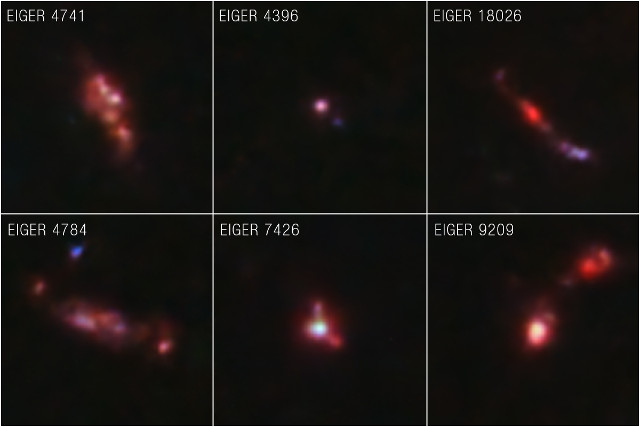
Some galaxies observed in this study, which we see as they were when the universe was 900 million years old

Three articles published in “The Astrophysical Journal” report various aspects of a study on the epoch of reionization and bring evidence that the first galaxies transformed the universe from an opaque place to the current place where light can spread. Researchers from the EIGER team led by Simon Lilly of the ETH Zurich, Switzerland, used the James Webb Space Telescope together with some ground-based telescopes to observe primordial galaxies finding transparent regions around them thanks to the reionization of the gas.

Image that celebrates the discovery of the exoplanet BEBOP-1 c (Image courtesy Amanda Smith / University of Birmingham)

An article published in the journal “Nature Astronomy” reports the discovery of a second circumbinary planet that orbits the two stars that form the BEBOP-1 system. A team of researchers used the HARPS and ESPRESSO spectrographs to find for the first time a circumbinary planet using the radial velocity method. This exoplanet, cataloged as BEBOP-1 c, joins TOI-1338 b, discovered in 2020 thanks to NASA’s TESS space telescope. Estimates indicate that BEBOP-1 c is a gas giant with a mass around 65 times the Earth’s and a year lasting about 215 Earth days.

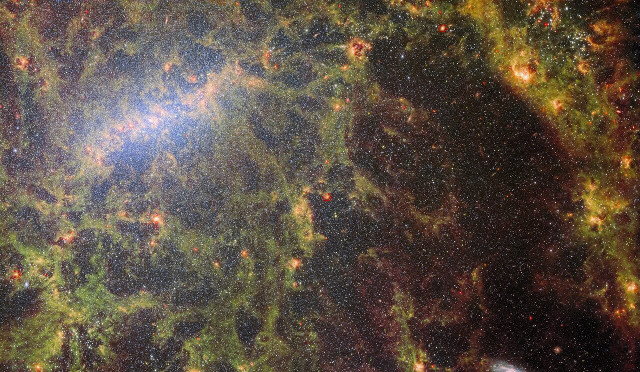
A part of the galaxy NGC 5068 as seen by the James Webb Space Telescope (Image ESA/Webb, NASA & CSA, J. Lee and the PHANGS-JWST Team)

An image captured by the James Webb Space Telescope shows the core and part of a spiral arm of the galaxy NGC 5068. Two instruments, MIRI and NIRCam, were used to examine this barred spiral galaxy, and the various infrared filters allowed to detect an enormous amount of detail among dusty structures and star-forming areas where there are newborn stars still surrounded by shells of gas and dust.

About 20 million light-years from Earth, the galaxy NGC 5068 belongs to the most common class in the universe, spiral galaxies. The presence of a star formation extending from the core in a shape resembling a bar places it in the subclass of the barred spiral galaxies, which probably make up about two-thirds of their class.

The Dragon 2 cargo spacecraft docked with the International Space Station in its CRS-28 mission (Image NASA TV)

A little while ago, SpaceX’s Dragon 2 spacecraft docked with the International Space Station’s Harmony module completing the first part of its CRS-28 mission. Astronaut Woody Hoburg monitored the operation assisted by his fellow astronaut Frank Rubio, but the cargo spacecraft, which blasted off when it was Monday morning in the USA, completed the maneuvers automatically without any problem.