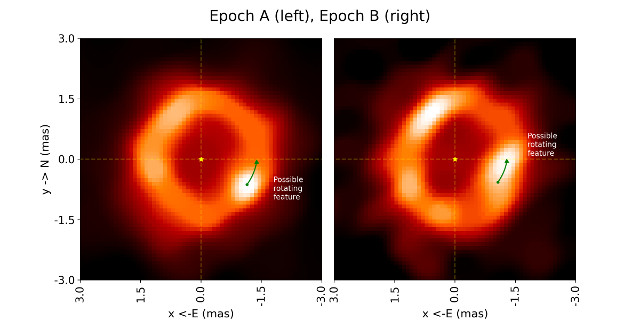
The V1295 Aquilae system with its protoplanetary disk seen one month apart by the CHARA interferometric array

An article published in “The Astrophysical Journal” reports a study based on the most detailed images obtained so far of the protoplanetary disk surrounding the very young star V1295 Aquilae. A team of researchers used CHARA’s array, the world’s largest optical and infrared interferometer, to obtain images of the inner area of the protoplanetary disk in detail never seen before. Despite this, the results lead to more questions than answers because they confirmed the presence of structures in the disk and emissions reported by previous studies but their characteristics still don’t have complete explanations.

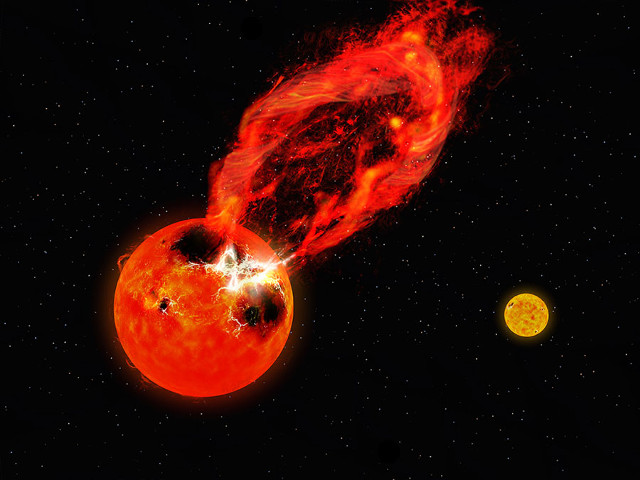
Artist's concept of the superflare in the Orionis V1355 system (Image courtesy National Astronomical Observatory of Japan)

An article published in “The Astrophysical Journal” reports the detection of a superflare in the V1355 Orionis system, a pair of stars of the variable RS Canum Venaticorum type, which features a more massive and evolved star than its companion. A team of researchers used space and ground-based telescopes to monitor the activity of the V1355 Orionis system, known for its powerful eruptions. This allowed to obtain continuous observations of this phenomenon, which was generated by a process called prominence eruption. This study offers new insights into these stellar phenomena that also occur on the Sun, albeit with a much smaller force.

M87 with its supermassive black hole and the jet it produces (Image R.-S. Lu (SHAO), E. Ros (MPIfR), S. Dagnello (NRAO/AUI/NSF))

An article published in the journal “Nature” reports the results of the first observations ever obtained of the ring structure showing matter falling into the supermassive black hole at the center of the galaxy M87. A team of researchers used the ALMA and GLT radio telescopes and some of the ones part of the GMVA array to obtain the images they were looking for. These images show not only the area around the black hole but also the flows of materials that originate a relativistic jet. The collected data is useful to understand the mechanisms that lead those jets to reach the energies necessary to be accelerated to speeds approaching the speed of light.

The surface of the Moon and the Earth in the background as seen by the Hakuto-R lander shortly before the attempted Moonlanding (Image courtesy ispace)

It was night in Tokyo when the Hakuto-R lander of the Japanese company ispace inc. attempted the Moon landing. Shortly before the touchdown, the team at the mission control center lost contact with Hakuto-R, and the last phase of the maneuver was followed only through a simulation based on the braking programming. After more than half an hour of trying to reconnect with the lander, company founder and CEO Takeshi Hakamada had to admit that he had to assume that the Moon landing could not be completed.

The galaxy cluster Abell 2744 and its surrounding area, including the views distorted by gravitational lensing of galaxies behind it. Among them are the seven galaxies identified in the A2744-z7p9OD protocluster, also seen in the insets.

An article published in “The Astrophysical Journal Letters” reports the evidence for the discovery of the oldest galaxy protocluster known so far. A team of researchers led by Takahiro Morishita of Caltech identified the cluster in its formation phase which was cataloged as A2744-z7p9OD with the Hubble Space Telescope and then confirmed with the James Webb Space Telescope the presence of at least seven galaxies. They were forming a larger structure about 650 million years after the Big Bang and according to calculations, the cluster has grown over time to include many other galaxies.