Asteroids

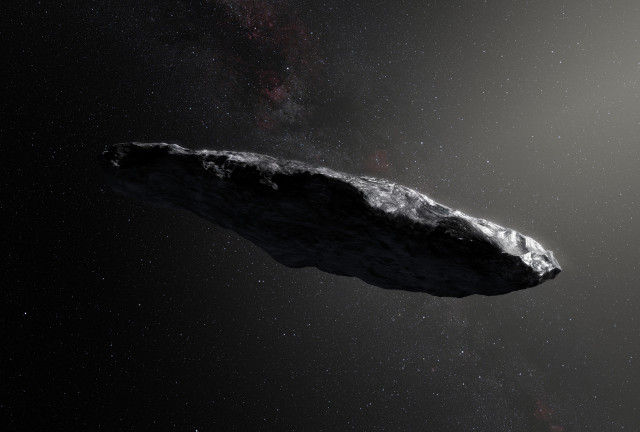
Artist's concept of the interstellar asteroid 'Oumuamua (Image European Southern Observatory/M. Kornmesser)

An article published in the journal “Monthly Notices of the Royal Astronomical Society” describes a research on the interstellar asteroid 1I/2017 U1, commonly known as ‘Oumuamua. A team of researchers tried to understand the implications of its passage in the solar system for planetary dynamics and the formation of planetesimals, the small celestial bodies that can accumulate materials to become planets. ‘Oumuamua could be a fragment of one ejected from its system and some clues suggest that its nature is cometary rather than asteroidal.

Artist's concept of New Horizon's Ultuma Thule flyby (Image NASA/JHUAPL/SwRI/Steve Gribben)

NASA has announced that it chose Ultima Thule as a nickname for 2014 MU69, the Kuiper Belt Object that represents the next target for its New Horizons space probe. In recent months, the mission team asked for suggestions on the Internet and then opened a ballot allowing to select the favorite among the nicknames selected among the thousands of proposals. The result is not an official name, which must be ratified by the International Astronomical Union (IAU), because it’s not clear if Ultima Thule is a single object.

Hyperbolic trajectory of ʻOumuamua

An article published in the journal “Nature Astronomy” describes a research on the tumbling of the interstellar asteroid 1I/2017 U1, commonly known as ‘Oumuamua. According to a team of astronomers led by Queen’s University Belfast, that motion is due to an impact with another object that occurred before it was ejected from its solar system and could continue for at least another billion years.

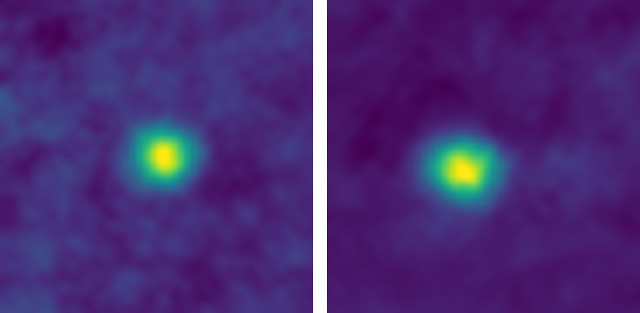
False-color photo of 2012 HZ84 and 2012 HE85 (Image NASA/JHUAPL/SwRI)

NASA has published some photos taken by its New Horizons space probe’s LORRI instrument in December 2017. During the course of its journey that will lead to the object called 2014 MU69’s flyby, New Horizons took photos that beat the record that belonged to Voyager 1 for the farthest photo ever taken from Earth capturing images of the open stellar cluster called Wishing Well and two Kuiper Belt Objects called 2012 HZ84 and 2012 HE85.

The interstellar asteroid 'Oumuamua seen by the William Herschel Telescope at La Palma (Image courtesy A. Fitzsimmons, QUB/Isaac Newton Group, La Palma)

An article published in the journal “Nature Astronomy” describes the results of a spectroscopic analysis and thermal modeling of the interstellar asteroid 1I/2017 U1 ‘Oumuamua. A team of astronomers led by Professor Alan Fitzsimmons and Dr. Michele Bannister from the School of Mathematics and Physics at Queen’s University Belfast concluded that, due to its exposure to cosmic rays, a superficial layering of organic and insulating materials occurred on the asteroid and it might contain ice.