
Asteroids

The occultation light curve of the background star caused by the passage of asteroid Chariklo captured by the James Webb Space Telescope's Near-infrared Camera (NIRCam) instrument

A stellar occultation that took place on October 18, 2022, made it possible to study asteroid Chariklo observing its rings as well, a truly peculiar feature for such a small object. A team of researchers used the James Webb Space Telescope to capture Chariklo’s passage in front of a star from Webb’s point of view. The NIRCam and NIRSpec instruments enabled images and spectrographic features of Chariklo to be obtained. In recent days, the NIRISS instrument had a software problem that blocked the transmission of the collected data but no hardware failures were found, therefore it’s possible that the data will be recovered later to complete an in-depth study of this asteroid.

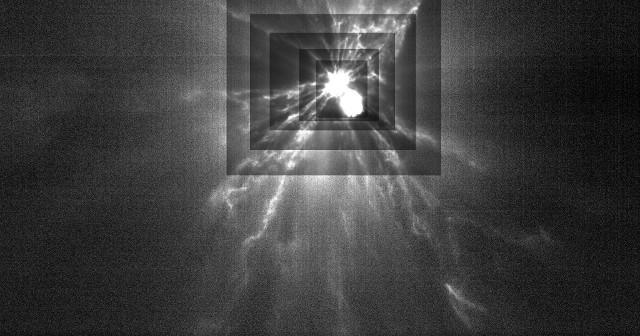
Asteroid Dimorphos and the ejected materials seen by LICIACube (Image ASI/NASA/APL)

In a press conference, NASA confirmed the success of its DART mission after ascertaining that the orbit of asteroid Dimorphos was changed by the impact of the spacecraft. According to calculations, Dimorphos now orbits the asteroid Didymos in 11 hours and 23 minutes while before the impact, it took 11 hours and 55 minutes for each orbit. The margin of error is approximately 2 minutes, which indicates that the success is far greater than the minimum predicted. The monitoring will continue, especially by the LICIACube mini-probe, to obtain more precise data, also on the materials ejected after the impact, as their characteristics will help to understand the composition of Dimorphos.

The asteroid Dimorphos a few seconds before the impact (Image NASA TV)

Yesterday, NASA’s DART spacecraft crashed into Dimorphos, a small asteroid satellite of Didymos, a larger asteroid. These two asteroids are visible from Earth using instruments powerful enough, which will be used to monitor Dimorphos’ orbit and how much it was modified by the impact. Nearby is LICIACube, a CubeSat-class mini-probe equipped with two cameras that will provide much better observations than any telescope on Earth.

Infographic that shows the various subsets of data covering a total of approximately 1,800,000,000 stars observed by the Gaia space probe

ESA has released the third 3D map of the sky including the Milky Way and nearby galaxies obtained from the Gaia space probe, the most detailed of its kind ever produced. This catalog, built thanks to what was called Data Release 3 (DR3), greatly expands the previous maps released by ESA in recent years. Some uncertainties regarding data processing, also caused by the start of the pandemic, led ESA to publish an anticipation of DR3 called EDR3 (Early Data Release 3) on December 3, 2020.

The DART spacecraft blasting off atop a Falcon 9 rocket (Image NASA)

A few hours ago, NASA’s DART mission was launched on a Falcon 9 rocket from the Vandenberg base. After about 56 minutes, the spacecraft successfully separated from the rocket’s last stage and set off on its way to reaching the binary asteroid Didymos to attempt to change the orbit of its satellite Dimorphos. The impact should take place in September 2022 and be monitored from Earth and the Italian Space Agency’s LICIACube nanosatellite launched together with the space probe.