Asteroids

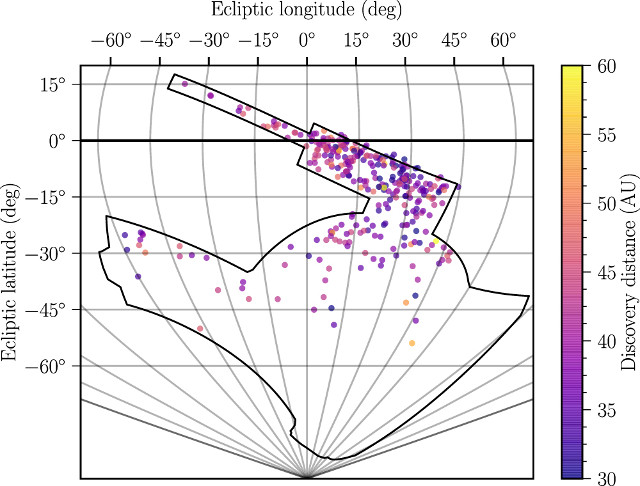
Position and distance diagram of the trans-neptunian objects detected

An article published in “The Astrophysical Journal” presents a catalog of 316 trans-neptunian objects detected by the Dark Energy Survey (DES) during the first four years of operations. A team led by Pedro Bernardinelli analyzed the data collected with a patient work to eliminate the fixed objects and then focused on the transient ones until they obtained the identification of 245 objects already known and 139 that were hitherto unknown. They’re at distances between 30 and more than 90 times the Earth’s from the Sun. Their detection will help to understand their origin and in general the Kuiper belt, where someone thinks that there may be another planet.

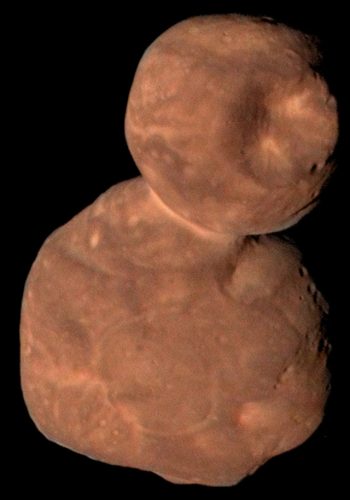
Arrokoth (Image NASA/Johns Hopkins University Applied Physics Laboratory/Southwest Research Institute/Roman Tkachenko)

Three articles published in the journal “Science” report various aspects of a research on the origins and characteristics of Arrokoth, the Kuiper Belt object classified as 2014 MU69 and for some time known by the nickname Ultima Thule. Different teams of researchers with various members in common used data collected by NASA’s New Horizons space probe to study it from various points of view. One of the conclusions concerns its origin, which might have occurred following the collapse of a cloud of solid particles in the primordial solar nebula and not following the process known as hierarchical accretion, a process that has high-speed collisions between planetesimals.

8-micron grain from the Murchison meteorite (Image courtesy Janaína N. Ávila)

An article published in the journal “Proceedings of the National Academy of Sciences” reports the dating of grains of silicon carbide that were part of the Murchison meteorite, which date back to different times with the oldest one dating back about 7 billion years ago. A team of researchers led by Philipp Heck of the University of Chicago analyzed particles contained in the Murchison meteorite by examining the elements contained and in particular the neon isotopes produced by galactic cosmic rays that struck those grains over time.

A fragment of Muonionalusta meteorite

An article published in the journal “Nature Astronomy” reports an analysis of the isotopic composition of six groups of iron meteorites, and the results offer evidence that some of the materials that formed the planet Earth came from red giant stars. Mattias Ek of the University of Bristol, Alison C. Hunt, Maria Lugaro and Maria Schönbächler examined in particular the isotopic composition of palladium finding that some dust has a composition that can be produced only by nuclear reactions that take place in red giants’ inner regions. This offers an explanation of the greater presence of that type of dust on Earth than on Mars or in asteroids.

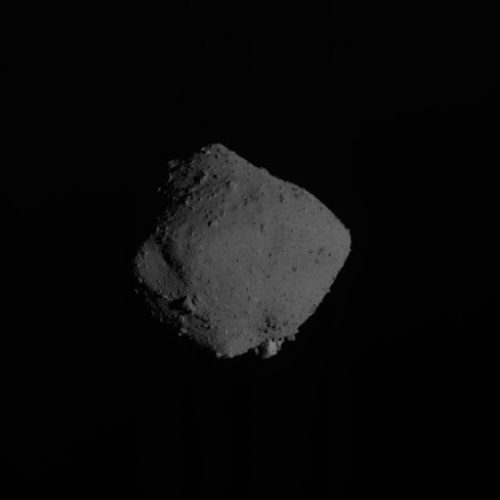
Asteroid Ryugu (Photo courtesy JAXA, Chiba Institute of Technology, University of Tokyo, Kochi University, Rikkyo University, Nagoya University, Meiji University, University of Aizu, AIST)

The Japanese space agency JAXA has confirmed that its Hayabusa 2 space probe has left asteroid Ryugu, reached on June 27, 2018. Until November 19 it will keep on taking pictures of Ryugu, a limit due to the fact that subsequently a maneuver needed to use its ion engine will lead it to turn into a position from which it will no longer have the asteroid in its camera’s view. Until that day, it will be possible to send a farewell message to Ryugu via Twitter or even letters and postcards to JAXA. Hayabusa 2 is scheduled to return near the Earth with its samples near the end of 2020.