
Astronauts

SpaceX's Crew Dragon Endurance spacecraft blasting off atop a Falcon 9 rocket in its Crew-7 mission (Image NASA TV)

A little while ago, SpaceX’s Crew Dragon Endurance spacecraft blasted off atop a Falcon 9 rocket from the Kennedy Space Center in its Crew-7 or SpaceX Crew-7 mission. After almost exactly twelve minutes, it successfully separated from the rocket’s last stage and went en route to carry out its mission. This is the 7th crewed mission of the Crew Dragon spacecraft within the normal rotation of the International Space Station crew. This is also the third mission for the Endurance. The launch takes place a day late because it took longer than expected to check the status of some valves of the life support system carried out after some of those of another Crew Dragon started corroding.

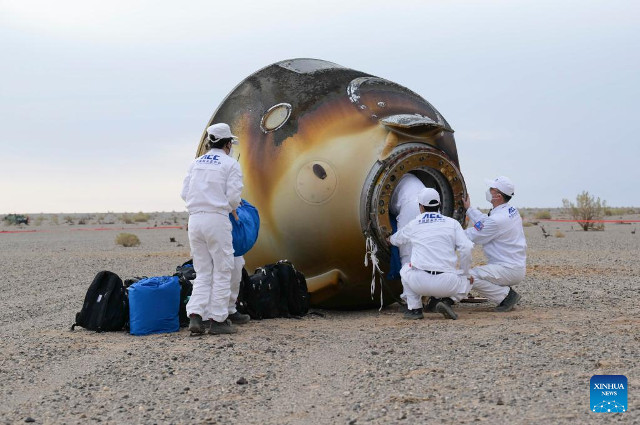
The Shenzhou 15 capsule after its landing (Photo courtesy Xinhua/Li Zhipeng)

A few hours ago, the three Chinese taikonauts of the Shenzhou 15 mission returned to Earth after spending a little more than six months on the Chinese space station Tiangong. The three taikonauts Fei Junlong, Deng Qingming, and Zhang Lu had left the station a few hours earlier to land at a site called Dongfeng in China’s Inner Mongolia Autonomous Region. A procedure that significantly reduces the time to return to Earth already tested in the past worked again and is becoming routine.

The Crew Dragon Freedom spacecraft recovered at the end of its Ax-2 mission (Photo courtesy SpaceX)

A few hours ago, SpaceX’s Crew Dragon Freedom spacecraft concluded its Ax-2 mission by splashing down without problems. On board were Peggy Whitson, Ali AlQarni, John Shoffner, and Rayyanah Barnawi, who ended this completely private space mission in the Atlantic Ocean after leaving the International Space Station about 12 hours earlier. Shortly after splashing down, SpaceX’s recovery ship went to retrieve the Freedom and its crew to transport them to the coast.

The Shenzhou 16 mission starting with the launch atop a Long March-2F rocket (Photo courtesy Xinhua/Li Gang)

A confirmation has arrived that three Chinese taikonauts from the Shenzhou 16 mission reached the Chinese space station Tiangong with an automated docking maneuver. They blasted off about seven hours earlier on a Long March-2F rocket from the Jiuquan Satellite Launch Center. They form the fifth crew of the Chinese space station and will remain there for about six months, the standard duration for a mission.

The Crew Dragon Freedom spacecraft begins the Ax-2 mission blasting off atop a Falcon 9 rocket (Image NASA TV)

A little while ago, SpaceX’s Crew Dragon Freedom spacecraft docked with the International Space Station’s Harmony module performing the first part of its private mission Axiom Mission 2 or simply Ax-2. It blasted off atop a Falcon 9 rocket from the Kennedy Space Center when it was afternoon in the USA. After verifying that the pressure is properly balanced, the hatch will be opened to allow crew members to enter the Station.

A little bit more than one year after the Ax-1 mission, a new collaboration between public entities, which this time besides NASA includes the Saudi Space Commission, and private ones, sent new astronauts to the International Space Station to conduct a series of scientific experiments on behalf of entities that generally can’t carry out studies in microgravity conditions.