Astronauts

The Crew Dragon Endeavour spacecraft docking with the International Space Station in its Crew-8 mission (Image NASA TV)

A little while ago, SpaceX’s Crew Dragon Endeavour spacecraft docked with the Harmony module of the International Space Station completing the first part of its Crew-8 or SpaceX Crew-8 mission that began with its launch about 28 hours earlier. After checking that the pressure gets properly balanced, the hatch will be opened to allow Aleksandr Grebenkin, Michael Barratt, Matthew Dominick, and Jeanette Epps to enter the Station and start their mission, which will last about six months.

The Crew Dragon Endeavour spacecraft blasting off atop a Falcon 9 rocket (Image NASA)

A few hours ago, SpaceX’s Crew Dragon Endeavour spacecraft blasted off atop a Falcon 9 rocket from the Kennedy Space Center in its Crew-8 or SpaceX Crew-8 mission. After almost exactly twelve minutes, it successfully separated from the rocket’s last stage and went en route to carry out its mission. This is the 8th crewed mission of the Crew Dragon spacecraft within the normal rotation of the International Space Station crew. This is also the 5th mission for the Endeavour, a new record. The fact that the Falcon 9 rocket’s first stage is new is almost more newsworthy.

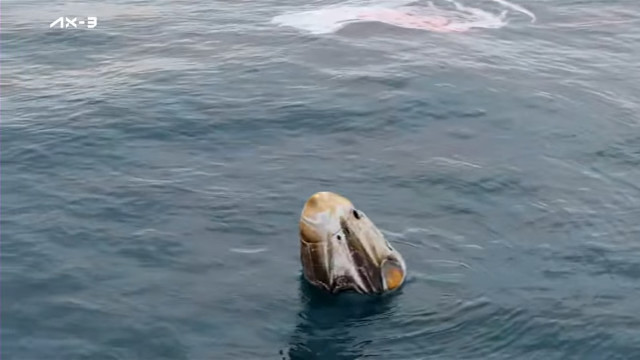
The Crew Dragon Freedom spacecraft after the splashdown that ended its Ax-3 mission (Image courtesy Axiom Space)

A little while ago, SpaceX’s Crew Dragon Freedom spacecraft concluded its Ax-3 mission by splashing down without problems. On board were Michael López-Alegría, Walter Villadei, Alper Gezeravcı, and Marcus Wandt, who ended this completely private space mission in the Atlantic Ocean after leaving the International Space Station almost 48 hours earlier. Shortly after splashing down, SpaceX’s recovery ship went to retrieve the Freedom and its crew to transport them to the coast.

The Crew Dragon Freedom spacecraft blasting off to begin the Ax-3 mission (Image courtesy Axiom Space)

A few hours ago, SpaceX’s Crew Dragon Freedom spacecraft was launched atop a Falcon 9 rocket from the Kennedy Space Center on the Axiom Mission 3, or simply Ax-3, mission. After about twelve minutes, it successfully separated from the rocket’s last stage. It will spend about 14 days in orbit, almost all of which will be docked at the International Space Station. It also serves commercial purposes in a collaboration between SpaceX, Axiom Space, and various companies and national space agencies to access the Station for the purpose of conducting tasks useful for the development of new technologies and for scientific research.

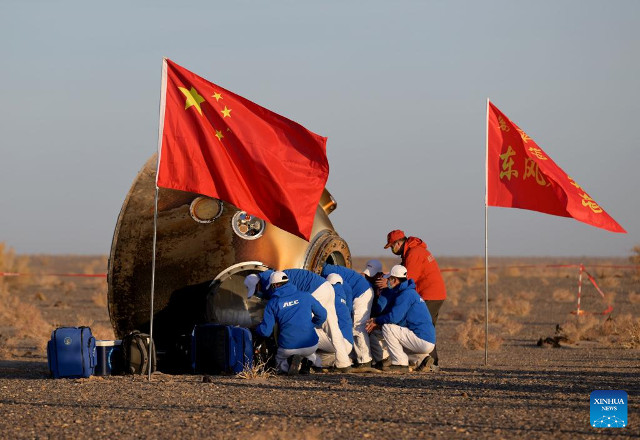
The Shenzhou 16 capsule after landing (Photo courtesy Xinhua/Li Zhipeng)

Yesterday, the three Chinese taikonauts of the Shenzhou 16 mission returned to Earth after spending 154 days on the Chinese Tiangong space station, landing at a site called Dongfeng in China’s Inner Mongolia Autonomous Region. During the capsule’s descent, some observers noticed a hole in the parachute. The speed of descent may have been faster than normal and the capsule toppled over after landing. It has already happened in the past that the capsule didn’t remain vertical and no consequences were reported for the taikonauts on board Gui Haichao, Jing Haipeng, and Zhu Yangzhu. In fact, there are no official communications regarding anomalies during the landing.