
Black holes

Blogs about black holes

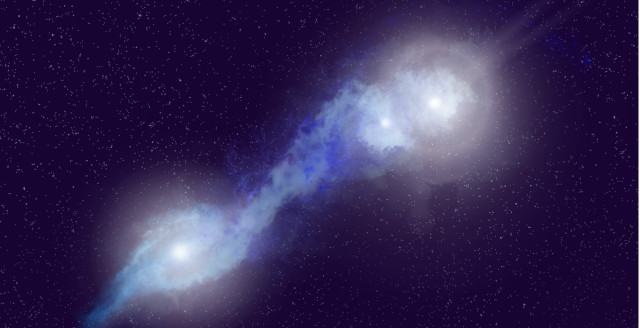
Artist's impression of the J1218/1219+1035 system (Image NSF/AUI/NSF NRAO/P. Vosteen)

A rare example of three active galactic nuclei in three merging galaxies has been discovered using two radio telescopes: the VLA and the VLBA. The triple system, approximately 1.2 billion light-years from Earth, is cataloged as J1218/1219+1035. This targeted study, conducted by a team of researchers at various radio frequencies, has identified only the third case of a triple active galactic nucleus, the first confirmed through radio observations. This discovery is useful for better understanding certain galaxy merger processes, such as the ones that led to the formation of the Milky Way.

Mosaic of candidate active galactic nuclei in dwarf galaxie

An article to be published in “The Astrophysical Journal” reports the discovery of about 2,500 new candidate active galactic nuclei in dwarf galaxies and about 300 new candidate intermediate-mass black holes. A team of researchers examined observations conducted with the Dark Energy Spectroscopic Instrument (DESI) on the Nicholas U. Mayall 4-meter Telescope in Arizona to find all these possible black holes.

Perseus and Centaurus galaxy clusters

An article published in the journal Nature Astronomy reports the results of a study of seven galaxy clusters which contain various supermassive black holes that offers evidence that outbursts generated at these black holes help cool the gas they feed on. A team of researchers used observations with multiple instruments to examine seven galaxy clusters. Outbursts in the form of jets from the supermassive black holes in those clusters cool the gas by forming thin filaments. Some of that gas will eventually flow back toward those black holes, triggering more outbursts in a mechanism in which the black holes “cook” their own meals.

Artist's concept of the most distant blazar (Image U.S. National Science Foundation/NSF National Radio Astronomy Observatory, B. Saxton)

Two articles – one published in the journal “Nature Astronomy” and one in “The Astrophysical Journal Letters” – report different aspects of a study of the blazar cataloged as VLASS J041009.05−013919.88, or simply J0410−0139, the most distant found so far. Two teams of researchers used several space and ground-based telescopes and some radio telescopes to obtain detections in various electromagnetic bands.

The center of the Centaurus galaxy A and the source C4 (Image NASA/CXC/SAO/D. Bogensberger et al.; Image Processing: NASA/CXC/SAO/N. Wolk)

An article published in the journal “The Astrophysical Journal” reports the results of X-ray observations of the jets emitted by the supermassive black hole at the center of the Centaurus A galaxy. A team of researchers used NASA’s Chandra X-ray Observatory to find a V-shaped structure that indicates that one of the jets hit something whose nature is uncertain. Only Chandra’s X-ray observations revealed that unusual structure, cataloged as C4, while many other instruments, especially radio telescopes, had never shown such anomalies.