Black holes

Mirabilis, Elstir and Vinteuil in a combination of X-ray and optical frequency observations

An article being published in “The Astrophysical Journal” reports the results of the study of two galaxy mergers between dwarf galaxies with active galactic nuclei. A team of researchers used data collected by NASA’s Chandra X-ray Observatory to discover candidates and then compared them with infrared observations conducted with NASA’s WISE Space Telescope and optical frequency observations conducted with the Canada-France-Hawaii Telescope (CFHT).

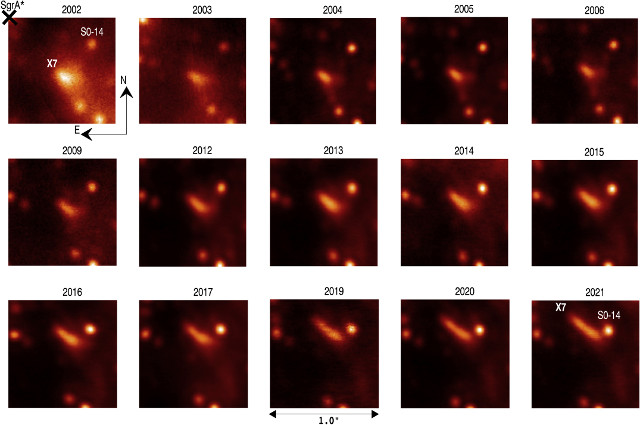
Some images captured by the NIRC2 instrument using adaptive optics showing the evolution of X7 between 2002 and 2021

An article published in “The Astrophysical Journal” reports the results of twenty years of observations of a giant filament of gas and dust that is progressively approaching Sagittarius A*, the supermassive black hole at the center of the Milky Way. A team of researchers from the Keck Observatory and UCLA’s Galactic Center Orbits Initiative (GCOI) used Keck’s OSIRIS and NIRC2 instruments to keep an eye on this filament, cataloged as X7, to study its orbit and shape’s evolution. According to predictions, in 2036, X7 will get close to Sagittarius A* to the point of dissipating and be devoured. This will be a really interesting event to study even more deeply what happens in that really extreme environment.

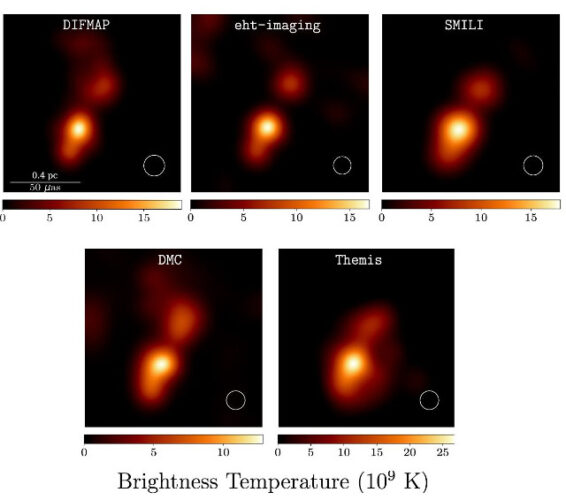
The results of the observations of the quasar NRAO 530 produced using the various methods to processed the data

An article published in “The Astrophysical Journal” reports the study of the quasar NRAO 530 conducted within the EHT (Event Horizon Telescope) project, which uses a combination of radio telescopes around the world to obtain images of areas around supermassive black holes. In this case, these are the innermost areas of NRAO 530, where gas and dust are heated to the point of generating strong electromagnetic emissions. About 7.5 billion light-years from the Earth, it’s the farthest supermassive black hole observed so far by the EHT project. The new details obtained on the structures present in this quasar’s central region are useful to understand the processes taking place in that extreme environment.

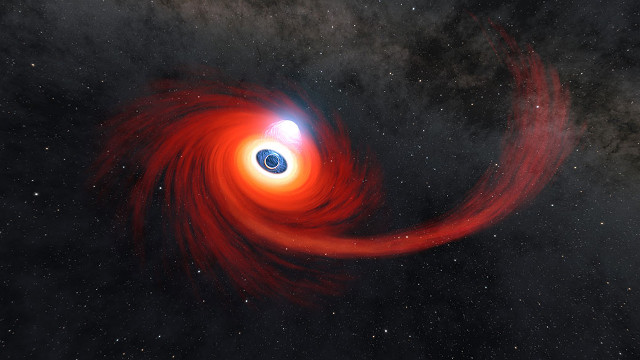
Artist's illustration of a tidal disruption event (Image NASA/JPL-Caltech)

An article published in “The Astrophysical Journal” reports the results of the observations of a supermassive black hole that is destroying a star. Cataloged as AT2021ehb, this is an event of the type technically called a tidal disruption event. A team of researchers used observations conducted with NASA’s NuSTAR and Swift space telescopes, the NICER instrument on the International Space Station, and other instruments to cover 430 days of the evolution of this process. This will help understand what happens to materials captured by a supermassive black hole before they’re completely swallowed.

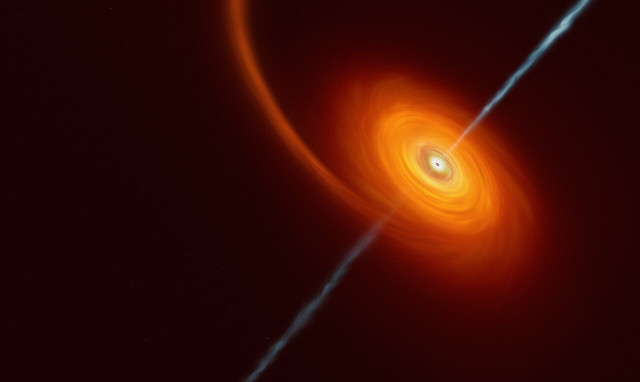
Artist's representation of the AT2022cmc event (Image ESO/M.Kornmesser)

Two articles, one published in the journal “Nature” and one in the journal “Nature Astronomy”, report different aspects of the study of the most distant supermassive black hole discovered as it devours a star and then emits a jet of materials accelerated at speeds close to the speed of light. The event, cataloged as AT2022cmc, is somewhat similar to a gamma-ray burst but was detected in various electromagnetic bands thanks to the fact that it’s aimed almost exactly at Earth. This is the first event of its kind detected in visible light, so it can offer new insights into the behavior of truly extreme objects during the destruction of a star that got too close to them.