Black holes

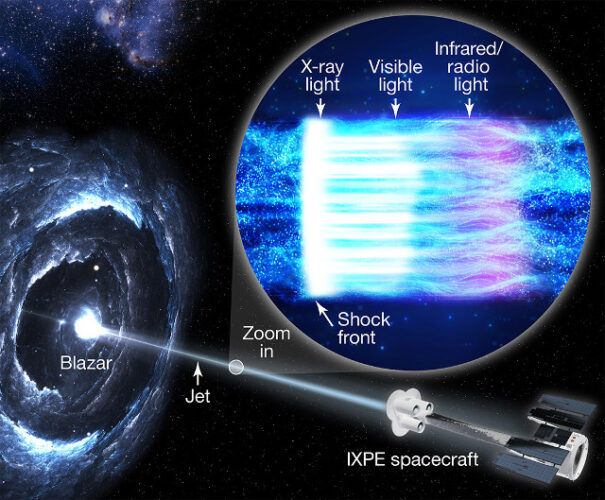
Diagram of the Markarian 501 blazar and its jet as observed with the IXPE Space Telescope

An article published in the journal “Nature” reports a study on the blazar Markarian 501, or simply MRK 501, which offers an explanation for the jets of particles emitted at speeds close to the speed of light. A team of researchers used NASA’s IXPE space telescope to study Markarian 501 and concluded that shock waves within the jets were the most likely explanation.

Markarian 501 is a blazar, a type of active galactic nucleus that emits powerful jets of particles at speeds approaching the speed of light. When one of its jets is aimed at Earth, this type of object is called a blazar. These objects are powered by supermassive black holes surrounded by disks of materials.

The star getting destroyed in the AT 2020neh event (Image NASA, ESA, Ryan Foley/UC Santa Cruz)

An article published in the journal “Nature Astronomy” reports a study of a so-called tidal disruption event, the destruction of a star by a black hole, in this case, an intermediate-mass black hole candidate. A team of researchers cataloged the event as AT 2020neh and studied it using the Hubble Space Telescope after its discovery, which happened thanks to the Young Supernova Experiment (YSE), a survey conducted using the Pan-STARRS telescopes. Intermediate-mass black holes are rare, at least as far as we know today, so each candidate discovered can offer new information, including on the possibility that they are precursors of supermassive black holes.

The GRB221009A gamma-ray burst observed by Swift (Image NASA/Swift/A. Beardmore (University of Leicester)

A record-breaking gamma-ray burst was observed thanks to a series of space and ground-based telescopes on October 9, 2022. The fast global alert system existing among astronomical organizations made it possible to use several instruments to detect the event and its consequences over the next few days. Cataloged as GRB221009A, it’s already been called the gamma-ray burst of the century because it was very powerful even by the standards of these extremely energetic events. It may have been caused by a supernova that gave birth to a black hole but studies of the information collected have just begun.

Artist's representation of the VFTS 243 system

An article published in the journal “Nature Astronomy” reports the discovery of a probable dormant black hole in the Large Magellanic Cloud, one of the dwarf galaxies satellite of the Milky Way. A team of researchers spotted it in the VFTS 243 system after a thorough examination of a binary system located in the Tarantula Nebula in which a candidate was identified to be tested in the search for black holes. Six years of observations conducted with ESO’s VLT allowed to rule out other possible explanations for the nature of the objects studied. An interesting conclusion is that the black hole discovered is the result of a collapse of the parent star that occurred without a supernova.

16 stars of the S cluster

An article published in “The Astrophysical Journal” reports the identification of the star with the closest orbit around Sagittarius A*, the supermassive black hole at the center of the Milky Way. A team of researchers cataloged it as S4716 after finding it in data collected over twenty years with the Keck Observatory, the VLT, and the VLTI. The star S4716 completes an orbit in about 4 Earth years and its distance from Sagittarius A* is as close as 100 times the Earth’s from the Sun. Its discovery, which breaks the record of the star S4711, is surprising and will help to better understand how stars in that area formed and moved, as it’s difficult to think that it formed this close to a supermassive black hole.