Black holes

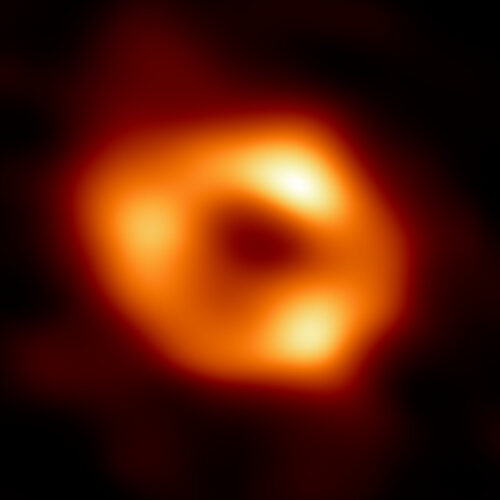
The area around Sagittarius A* (Image courtesy EHT Collaboration)

In various press conferences, representatives of the institutions collaborating in the Event Horizon Telescope (EHT) project announced that they obtained the first image of the area around Sagittarius A*, the supermassive black hole at the center of the Milky Way. The central shadow, which constitutes the black hole, is surrounded by a sort of ring formed by gas and dust that glow because they were heated by Sagittarius A*. It took the combination of 8 radio telescopes to obtain proof of the existence of this supermassive black hole, taken for granted by the vast majority of scientists but still denied by some.

The galaxies NGC 1385, NGC 1566, NGC 3344, and NGC 6503

An article published in “The Astrophysical Journal” reports the results of a study conducted on 108 galaxies containing nuclear star clusters in search of intermediate-mass black holes. A team of researchers used NASA’s Chandra X-ray Observatory to look for the traces of this type of black hole that has so far been very elusive. In 29 of these galaxies, they found emissions they believe came from this type of black hole and traces of the destruction of thousands of stars. This suggests that intermediate-mass black holes grow by devouring stars.

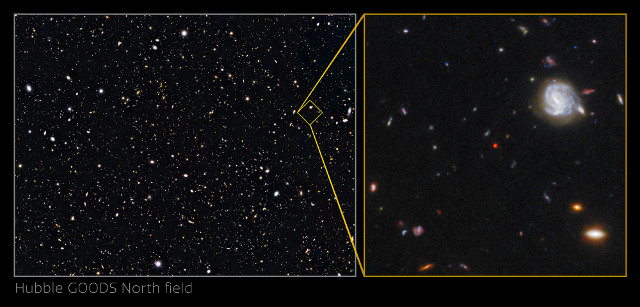
GNz7q with the likely supermassive black hole precursor in red

An article published in the journal “Nature” reports the discovery of a possible precursor of a supermassive black hole in the early universe. A team of researchers discovered the object cataloged as GNz7q in the data of the GOODS survey conducted by combining observations made with different telescopes. From Earth, we see GNz7q as it was about 750 million years after the Big Bang and its emissions can only be partially explained by a remarkable star formation. The conclusion is that there’s probably a supermassive black hole growing within the dust that fills up the primordial galaxy’s nucleus and over time it will become a quasar, a type of extremely bright active galactic nucleus.

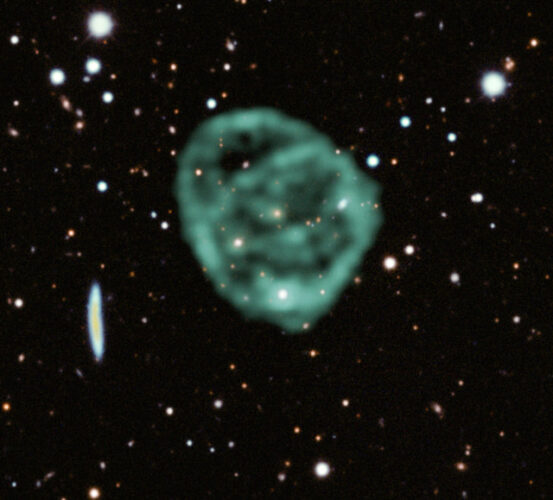
ORC1 seen by MeerKAT and in the background optical data from the Dark Energy Survey (Image J. English (U. Manitoba)/EMU/MeerKAT/DES(CTIO))

An article published in the journal “Monthly Notices of the Royal Astronomical Society” reports a study based on a new image of a so-called odd radio circle (ORC). A team of researchers used the MeerKAT radio telescope to observe this structure with a diameter of over one million light-years visible only at radio waves. Each new observation of this type of phenomenon offers new information, as only five of them are known at the moment. The information collected with MeerKAT could help verify the theories that were proposed and reach a reasonably certain explanation for its origin and nature.

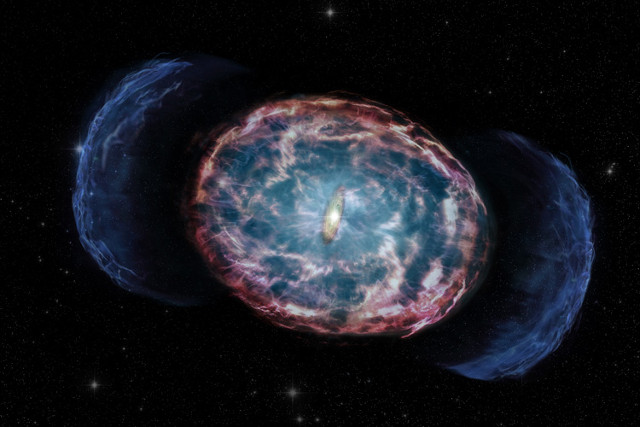
Artist's representation of the evolution of the GW170817 kilonova

An article accepted for publication in “The Astrophysical Journal Letter” reports a study based on the X-ray emissions from the kilonova generated by the merger of two neutron stars in the event detected by gravitational waves on August 17, 2017, and cataloged as GW170817. A team of researchers used observations conducted with NASA’s Chandra X-ray Observatory in the years following the first detection to monitor the evolution of the kilonova’s remnants. So far, this is the only kilonova identified with certainty and it was detected at both electromagnetic and gravitational waves but there’s still no certainty of what was produced by the GW170817 event. The X-ray emissions could indicate that a black hole was born but they could be emissions that are a kind of afterglow of the kilonova.