Black holes

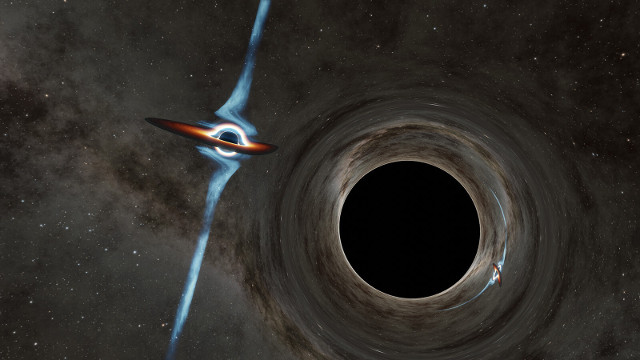
Artist's concept of the blazar PKS 2131-021 with its pair of supermassive black holes (Image courtesy Caltech/R. Hurt (IPAC))

An article published in “The Astrophysical Journal Letters” reports a study on the blazar cataloged as PKS 2131-021 that offers evidence that it contains a pair of supermassive black holes orbiting each other in a period of two years. A team of researchers used data collected from different telescopes with radio observations going back in time to 1975 to reconstruct what happens inside PKS 2131-021 by exploiting its nature as a blazar. That’s because, by definition, a blazar is powered by a supermassive black hole that emits a jet of materials at very high speeds oriented towards the Earth. The examination of the jet from PKS 2131-021 showed movement caused by the orbital movements of the black hole and a companion around each other. According to the researchers, from the Earth’s point of view, these two supermassive black holes will merge in about 10,000 years.

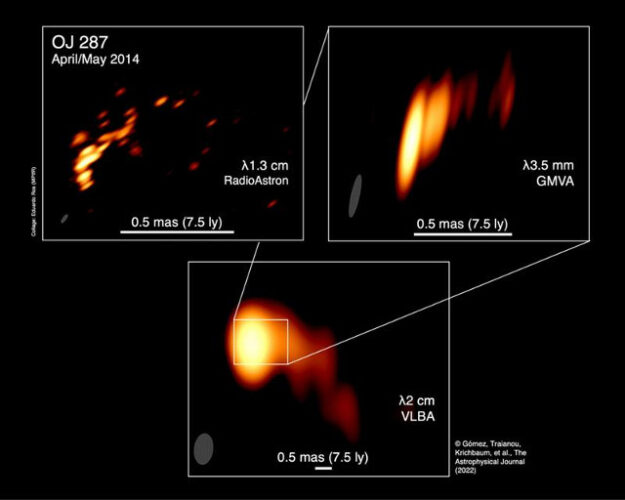
The blazar OJ 287 observed at different wavelengths by RadioAstron, GMVA, and VLBA

An article published in “The Astronomical Journal” reports observations of the blazar OJ 287 conducted by combining different radio telescopes in various areas of the world and the RadioAstron antenna in space. A team of researchers obtained in this way the highest resolution images obtained so far of OJ 287. They confirm the presence of two supermassive black holes powering the active galactic nucleus, one of the reasons why this blazar has been the focus of many scientists’ interest for a long time.

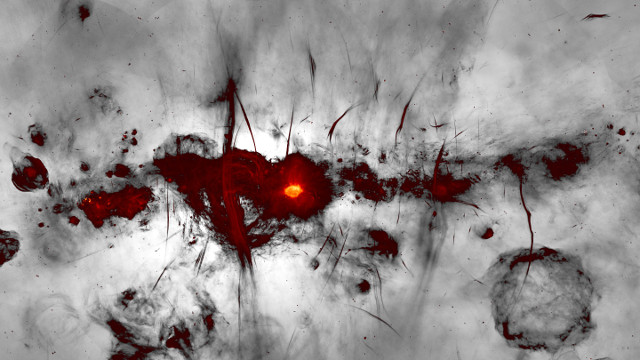
The Milky Way center as seen by MeerKAT

Two articles accepted for publication, one in “The Astrophysical Journal” and one in “The Astrophysical Journal Letters”, report different aspects of a study on the Milky Way’s center. A team of researchers used the MeerKAT radio telescope to examine the galactic center with a clarity and depth never obtained before. This made it possible to obtain new information on radio bubbles, supernova remnants, star nurseries, the region around the supermassive black hole at the center of the Milky Way, and many radio filaments.

The Andromeda galaxy (M31) with the cluster B023-G078

An article published in “The Astrophysical Journal” reports the discovery of a rare intermediate-mass black hole in the Andromeda galaxy at the center of what could be a stripped nucleus, what remains of a galaxy swallowed by Andromeda. A team of researchers observed the star cluster cataloged as B023-G078 at the Gemini Observatory and with the Hubble Space Telescope to calculate the mass distribution within it, a crucial step to understand its nature as a stripped nucleus and identify the intermediate-mass black hole. This could be a way to discover this rare type of black hole, which some models claim merges with others to form supermassive black holes following galaxy mergers.

The dwarf galaxy Henize 2-10

An article published in the journal “Nature” reports a study on the dwarf galaxy Henize 2-10 that offers evidence that the supermassive black hole at its center stimulated star formation. Zachary Schutte and Amy Reines relied on observations conducted with the Hubble Space Telescope to find a kind of hot gas bridge that connects the black hole to a region of intense star formation and to connect the black hole’s outflow to that star nursery. These conclusions are useful to understand the influence of supermassive black holes on their host galaxies and their origin.