Black holes

The galaxy Centaurus A seen by the WMA (Image Ben McKinley, ICRAR/Curtin and Connor Matherne, Louisiana State University)

An article published in the journal “Nature Astronomy” reports the observation of a cosmic eruption in the galaxy Centaurus A which, despite being about 12 million light-years away, has an extension in the Earth’s sky equivalent to that of 16 full Moons side by side. A team of researchers used the MWA radio telescope to detect the radio emissions generated by the supermassive black hole at the center of Centaurus A. The observations show a gigantic bipolar outflow with unprecedented quality. This allowed confirming a new interdisciplinary theory known as CCA (Chaotic Cold Accretion) regarding the interaction between the gas halos possessed by galaxies and the supermassive black holes they host.

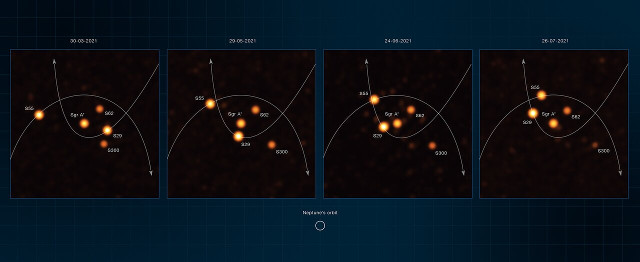
Some of the stars orbiting Sagittarius A*

Two articles published in the journal “Astronomy & Astrophysics” report aspects of a research on Sagittarius A*, the supermassive black hole at the center of the Milky Way. The GRAVITY collaboration and other researchers used ESO’s VLTI in Chile to observe stars around Sagittarius A* at a magnification 20 times greater than what was possible before the VLTI. This enabled to discover another star relatively close to the supermassive black hole, and by examining the orbit of that and other stars in that area, they estimated the mass of Sagittarius A* with greater precision.

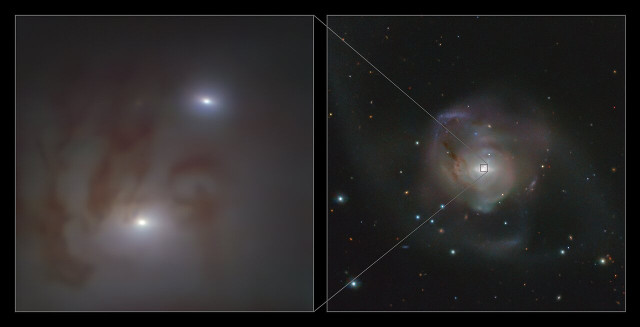
The galaxy NGC 7727 and its pair of supermassive black holes seen by the VLT

An article published in the journal “Astronomy & Astrophysics” reports the detection of a pair of supermassive black holes in the galaxy NGC 7727. A team of researchers used ESO’s VLT to conduct the observations that led to a discovery that broke two records in this field. The two supermassive black holes are the closest pair discovered so far at about 89 million light-years from Earth and are the closest to each other, as their distance was estimated to be around 1,600 light-years.

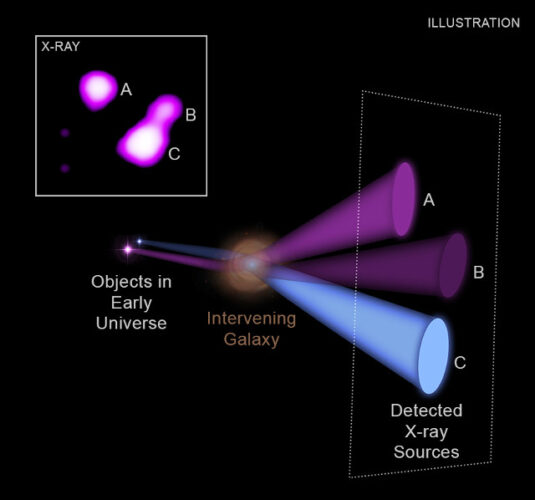
Illustration of MG B2016+112

An article published in “The Astrophysical Journal” reports a study on a double X-ray source in the early universe cataloged as MG B2016+112 which could be composed of two supermassive black holes whose image is distorted by a gravitational lens. Cristiana Spingola, Daniel Schwartz, and Anna Barnacka started from a survey obtained by NASA’s Chandra X-ray Observatory to examine the double object observed. This is an unprecedented situation because from the Earth we see it as it was when the universe was about two billion years old with the two components separated by only 650 light-years. At present, it cannot be ruled out that it’s a single supermassive black hole and one of its jets of materials whose image was strongly distorted by the gravitational lens.

The galaxy Hercules A

A series of ten articles to be published in the journal “Astronomy & Astrophysics” reports the results of the activity of the LoFar network with its 70,000 antennas with unprecedented details of various galaxies at radio frequencies. A team of astronomers has published these results consisting of astronomical images obtained by making the most of the LoFar network’s capabilities. This made it possible to obtain images twenty times sharper than the previous ones generated by LoFar.