Black holes

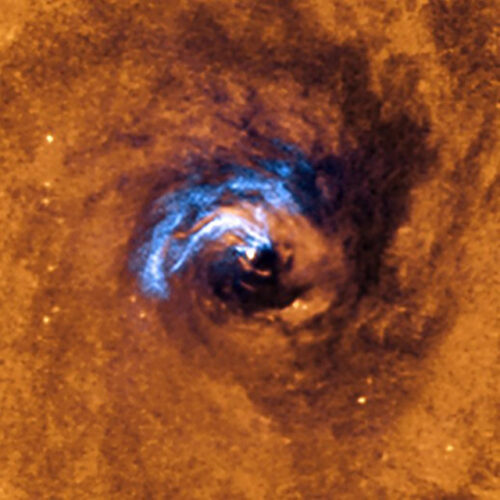
The process that was called nuclear feeding of the galaxy NGC 1566's supermassive black hole

An article published in the journal “Monthly Notices of the Royal Astronomical Society” reports a study on the feeding process of the supermassive black hole at the center of the galaxy NGC 1566. A team of researchers led by Almudena Prieto of the Instituto de Astrofísica de Canarias (IAC) used observations conducted with the Hubble Space Telescope, the VLT, and the ALMA radio telescope in Chile to be able to visualize filaments of interstellar dust that separate and subsequently head towards the supermassive black hole, approaching it in a spiral trajectory that eventually leads them to be swallowed. Those filaments could obscure the center of many galaxies with active galactic nuclei.

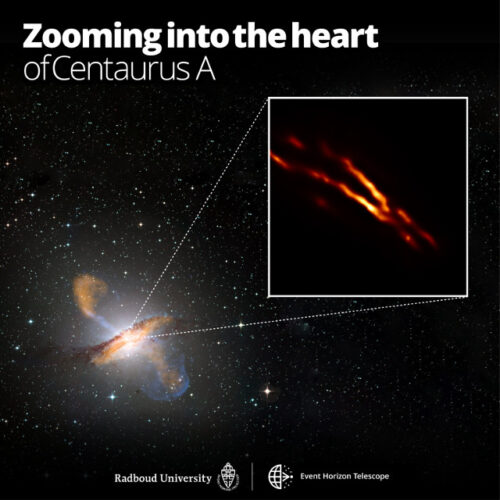
Centaurus A at high resolution in the inset superimposed on an image of the galaxy hosting the supermassive black hole

An article published in the journal “Nature Astronomy” reports observations of the jets emitted by the supermassive black hole at the center of the radio galaxy Centaurus A with details never seen before thanks to the combination of different radio telescopes. A team of researchers including the Event Horizon Telescope (EHT) collaboration used the same technique that made it possible to obtain the historical image of the area around the supermassive black hole at the center of the galaxy M87. The Centaurus A observations took place in 2017 and now the results arrived, especially the details of the jets.

The central area of ​​the Milky Way with SgrA*

An article accepted for publication in the journal “Astronomy & Astrophysics” reports a study on Sagittarius A*, or SgrA*, the supermassive black hole at the center of the Milky Way, observed during a flare after it swallowed gas and dust in large quantities. A team of researchers used observations conducted simultaneously in 2019 with the GRAVITY instrument on ESO’s VLT interferometer and with the Spitzer, NuSTAR, and Chandra space telescopes to obtain infrared and X-ray data of the flare. This made it possible to create a detailed model of that type of flare.

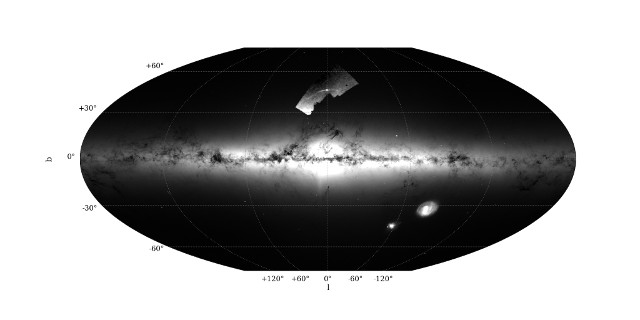
A view of the sky with Palomar 5 at the top-center

An article published in the journal “Nature Astronomy” reports a study on the star cluster Palomar 5 that indicates that in a billion years only black holes will remain inside it. A team of researchers led by Professor Mark Gieles of the University of Barcelona studied this ancient and very low-density cluster by conducting a series of simulations to try to predict its future. The number of black holes inside it is already above average today and is subject to gravitational interactions with the consequence that in the distant future its size will increase and only black holes will remain.

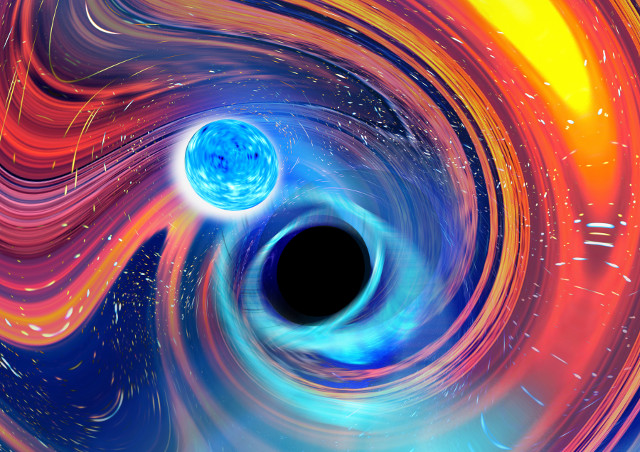
Artist's concept of merger between a black hole and a neutron star. (Image courtesy Carl Knox, OzGrav - Swinburne University)

An article published in “The Astrophysical Journal Letters” reports the detection of gravitational waves emitted by two cases of mergers of a black hole with a neutron star. Scientists from the LIGO, Virgo, and KAGRA collaborations examined data collected by the Advanced LIGO and Advanced Virgo detectors to find evidence of this type of merger in two events detected in January 2020. Previously, there were other candidates but the data left various doubts about the nature of the objects that merged.