Black holes

The Quasar J1342+0928 (Image courtesy Mpia / Venemans et al.)

Two articles, one published in the journal “Nature” and one published in the “Astrophysical Journal Letters”, describe different aspects of a research that led to the discovery of the oldest known supermassive black hole. According to an estimate it formed about 690 million years after the Big Bang and it’s difficult to explain how it reached 800 million times the Sun’s mass. Labeled as Ulas J134208.10+092838.61 or more simply as J1342+0928, it may have formed during the so-called reionization period.

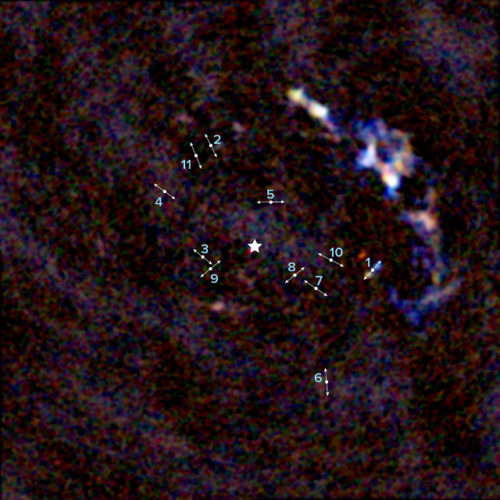
The protostars detected by ALMA (Image ALMA (ESO/NAOJ/NRAO), Yusef-Zadeh et al.; B. Saxton (NRAO/AUI/NSF))

An article published in the “Astrophysical Journal Letters” describes the discovery of protostars near the center of the Milky Way, near the supermassive black hole known as Sagittarius A* (or Sgr A*). A team of astronomers made this discovery using the ALMA radio telescope, a surprising result because the conditions in that area were considered too hostile due to the gravitational tides caused by Sgr A* and the intense electromagnetic emissions from the heated gas and dust ring around it.

Two possible pairs of supermassive black holes

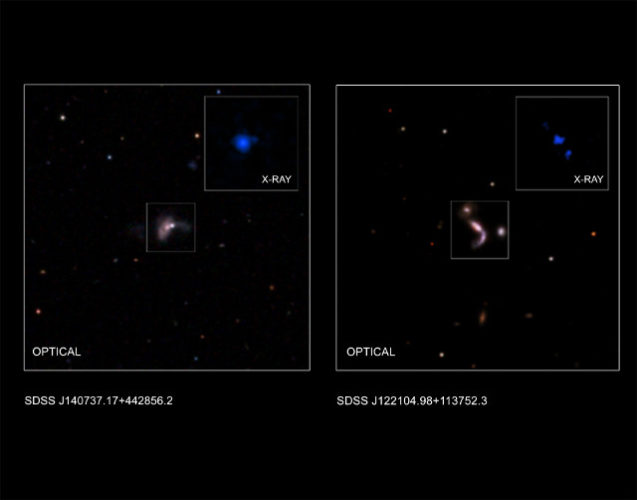
Two articles, one recently accepted for publication in “The Astrophysical Journal” and one published in the journal “Monthly Notices of the Royal Astronomical Society” (MRAS), describe as many researches on pairs of supermassive black holes. In total, five candidates could form as many pairs of black holes with masses millions of times the Sun’s at the center of galaxies. At a time when gravitational wave research obtained historical results, very powerful sources could be very useful for new studies.

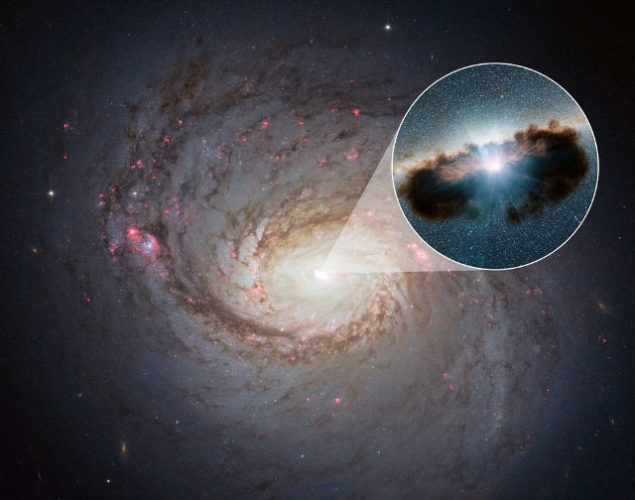
The galaxy NGC 1068 with its active galactic nucleus (Image NASA/JPL-Caltech)

An article published in the journal “Nature Astronomy” describes a research about the relationship between Active Galactic Nuclei (AGNs) and the galaxies that host them. Cristina Ramos Almeida of the Instituto de Astrofísica de Canarias (IAC) and Claudio Ricci of the Institute of Astronomy of the Universidad Católica de Chile used data collected by various space and ground-based telescopes to understand the effect of that activity, called in jargon AGN feedback, which can manifest in different ways, favoring or inhibiting star formation in their galaxies.

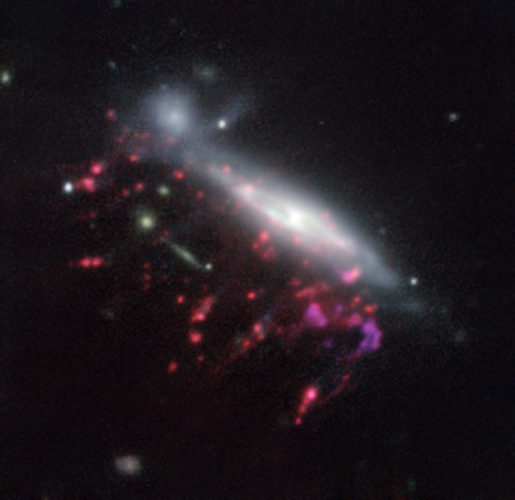
The jellyfish galaxy JO204 (mage ESO/GASP collaboration)

An article published in the journal “Nature” describes a research that shows a new function of the “tentacles” of the so-called jellyfish galaxies. An international team of astronomers led by Bianca Poggianti of the INAF-Astronomical Observatory of Padua in Italy used the observations conducted during ESO’s GASP program with the MUSE instrument installed on the Very Large Telescope (VLT), discovering that the mechanism that generates those tentacles is the same that powers the supermassive black holes at the center of those galaxies.