Black holes

A portion of space simulated by the Illustris project showing the distribution of dark matter (Image courtesy Markus Haider / Illustris collaboration)

An article published in the journal “Monthly Notices of the Royal Astronomical Society” describes a research on the distribution of matter in the universe. According to the results 20% of ordinary matter is contained in the so-called cosmic voids and galaxies are only 1/500th of the volume of the universe. A team led by Dr Markus Haider of the Institute of Astro and Particle Physics at the University of Innsbruck in Austria, has used simulations of the Illustris project to reach these conclusions.

The gravitational waves detected by LIGO (Image courtesy LIGO)

In Washington, D.C. a press conference was held to announce that the LIGO experiment found the gravitational waves predicted by Albert Einstein’s theory of general relativity. Two blacks holes about 1.3 billion light years from Earth merged as a result of a collision emitting those waves.

LIGO (Laser Interferometer Gravitational-Wave Observatory) is an instrument designed specifically to detect gravitational waves. It was created in a collaboration between Caltech (California Institute of Technology) and MIT (Massachusetts Institute of Technology) with funding from the American NFS (National Science Foundation).

The galaxy NGC 4845 photographed by the Hubble Space Telescope (Image ESA/Hubble & NASA and S. Smartt (Queen's University Belfast))

The Hubble Space Telescope took a photograph of the galaxy NGC 4845. At its core, it contains a supermassive black hole, a fact now considered normal but that can be detected only indirectly, through the gravitational effects on stars near to the galactic core. During the observations, it swhoed a remarkable appetite as in 2013 it swallowed in a short time a mass several times that of the planet Jupiter.

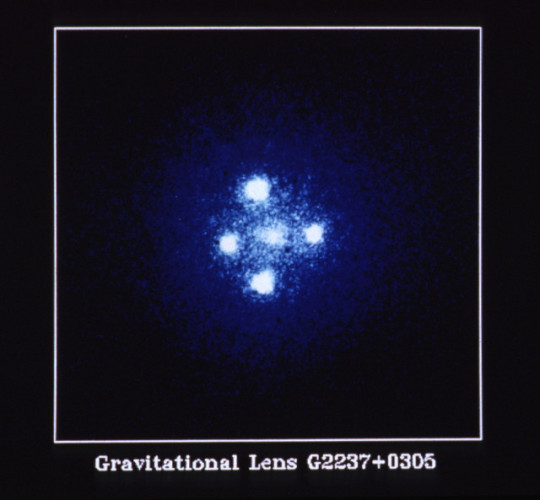
The quasar Q2237+0305 nicknamed Einstein Cross photographed by the Hubble Space Telescope (Image NASA, ESA, and STScI)

An article published in “The Astrophysical Journal Letters” describes a research on the quasar Q2237+0305 nicknamed Einstein Cross or Einstein’s Cross. Through the technique of gravitational microlensing a team of Spanish astrophysicists carried out the most accurate measures of the innermost region belonging to the disc of materials spinning around the supermassive black hole that feeds this quasar.

Galaxy NGC 1068 seen by the Hubble Space Telescope. In the circle there's an artist concept of the doughnut of gas and dust surrounding the supermassive black hole at its center (ImageNASA/JPL-Caltech)

An article published in the journal “Monthly Notices of the Royal Astronomical Society letters” describes a research on the supermassive black hole at the center of the galaxy NGC 1068. An international team of astronomers led by Andrea Marinucci of the Roma Tre University in Italy used ESA’s XMM-Newton and NASA’s NuSTAR space telescopes to study the giant doughnut-shaped structure around the supermassive black hole.