Black holes

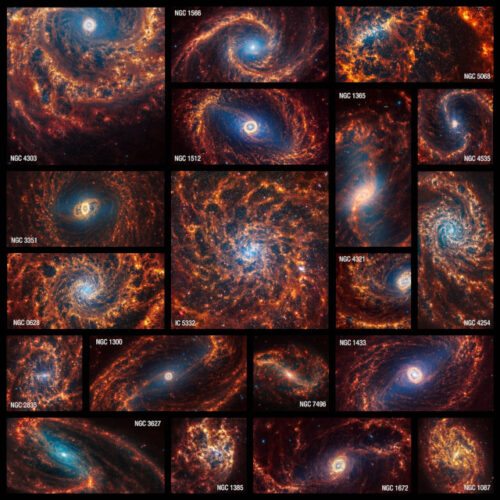
Mosaic of the 19 spiral galaxies studied by the PHANGS project

The images of 19 spiral galaxies captured by the James Webb Space Telescope have been released as part of the PHANGS (Physics at High Angular resolution in Nearby GalaxieS) project. These are galaxies up to 65 million light-years away that we see face-on, and this allows to better observe the stars inside them, an optimal situation for a project focused on star formation processes. Webb’s NIRCam (Near-Infrared Camera) and MIRI (Mid-Infrared Instrument) instruments were employed to cover the near and mid-infrared resulting in many new details.

LEDA 60847 (Image NASA/ESA/A. Barth (University of California - Irvine)/M. Koss (Eureka Scientific Inc.)/A. Robinson (Rochester Institute of Technology)/Processing: Gladys Kober (NASA/Catholic University of America))

An image captured by the Hubble Space Telescope shows LEDA 60847, a group of interacting galaxies. The largest galaxy has an active galactic nucleus (AGN) with a supermassive black hole surrounded by materials that are heated to the point of generating the electromagnetic emissions behind its luminosity. This galaxy is interacting with its neighbors and in a very long time, they will form a single larger galaxy.

Artist's impression of the compact object in the black hole mass gap with the NGC 1851E pulsar at the top (Image courtesy Daniëlle Futselaar (artsource.nl))

An article published in the journal “Science” reports the discovery of a compact object within the globular cluster cataloged as NGC 1851 whose nature is uncertain because mass estimates place it on the border between a neutron star and a black hole. A team of researchers used observations conducted with the MeerKAT radio telescope to identify traces of a binary system composed of a so-called millisecond pulsar and the mysterious compact object. The estimated mass for this object is between 2.09 and 2.71 times the Sun’s, so it could be a massive neutron star or a small black hole.

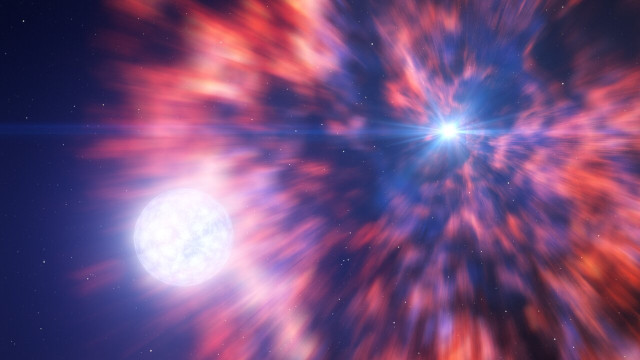
Artist's concept of the aftermath of a supernova in a binary system (Image ESO/L. Calçada)

Two articles, one published in the journal “Nature” and one in “The Astrophysical Journal Letters”, report different aspects of a study of the supernova remnant cataloged as SN 2022jli which include evidence of the presence of a compact object that could be a neutron star or a black hole that formed after the supernova. Two teams of researchers used various instruments including the Very Large Telescope (VLT) and the New Technology Telescope (NTT), both ESO’s, to study the consequences of this supernova and find the direct link to the formation of a compact object.

The central area of the Milky Way as seen by the Subaru telescope. Several stars are visible in an area about 0.4 light-years across. The star S0-6 is circled in blue while the area where the supermassive black hole Sagittarius A* is located is circled in green.

An article published in the journal “Proceedings of the Japan Academy, Series B, Physical and Biological Sciences” reports a study on the star cataloged as S0-6 which indicates that it formed in another galaxy and only over time reached the center of the Milky Way. Since 2014, a team of researchers led by Shogo Nishiyama of Miyagi University of Education in Japan has been studying various stars that now orbit Sagittarius A*, or simply Sgr A*, the supermassive black hole at the center of the Milky Way.