Black holes

An artistic illustration of the test of the postquantum theory of classical gravity

An article published in the journal “Physical Review X (PRX)” proposes what is called a postquantum theory of classical gravity. Professor Jonathan Oppenheim of University College London (UCL) offers a different approach to that adopted by most of his colleagues by proposing to modify quantum theory to unify it with relativistic gravity. An article published in the journal “Nature Communications” offers some reflections from Professor Oppenheim’s former Ph.D. students on the consequences of his theory and proposes an experiment to verify it.

galaxy UHZ1 as seen by the Chandra X-ray Observatory and the James Webb Space Telescope

An article published in the journal “Nature Astronomy”, one published in “The Astrophysical Journal Letters”, and one submitted for publication in “The Astrophysical Journal” report different aspects of the study of the most distant black hole detected at X-rays. Different teams of researchers combined data obtained with the Chandra X-ray Observatory and the James Webb Space Telescope to study the galaxy UHZ1 in X-ray and infrared light. The result is the discovery of a growing supermassive black hole approximately 470 million years after the Big Bang. The study offers evidence that it was born already having considerable mass, confirming that supermassive black holes grow from seeds that form from the direct collapse of enormous amounts of gas.

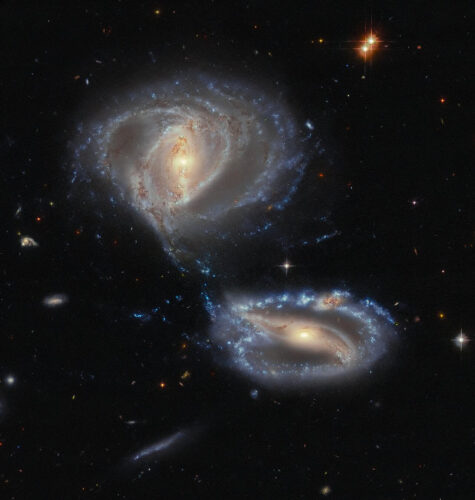
Arp-Madore 2339-661 (Image ESA/Hubble & NASA, J. Dalcanton, Dark Energy Survey/DOE/FNAL/NOIRLab/NSF/AURA Acknowledgement: L. Shatz)

An image captured by the Hubble Space Telescope depicts Arp-Madore 2339-661, an object that until not many years ago was considered a pair of interacting galaxies, cataloged as NGC 7733 (bottom right) and NGC 7734 (top left). However, observing the upper arm of NGC 7733, it’s possible to see a sort of large knot of a color different from the predominant blue which is actually a dwarf galaxy, now cataloged as NGC 7733N. The consequence is that the interaction taking place is what some call a merging group. Mergers between two galaxies are normal but sometimes there are more galaxies and in this case, there are three of them that show signs of having active galactic nuclei.

International Gemini Observatory/NOIRLab/NSF/AURA/P. Marenfeld QuasarPōniuāena

An article published in “The Astrophysical Journal Letters” reports the discovery of the most distant cold molecular gas in the interstellar medium of the galaxy that hosts the quasar nicknamed Pōniuāʻena, one of the three most distant bright quasars known. A team of researchers led by some associates of the Italian National Institute of Astrophysics (INAF) used observations conducted with the NOEMA (Northern Extended Millimeter Array) radio telescope to obtain the detection of the gas, to be precise carbon monoxide. This study can provide valuable information to understand how a supermassive black hole could have a mass 1.5 billion times the Sun’s when the universe was “only” 700 million years old.

The so-called ultradeep field used in the MIDIS survey and on the right, some of the primordial galaxies at the center of this study are highlighted in the circle

An article published in “The Astrophysical Journal Letters” reports a study indicating that the early universe was much brighter than predicted by simulations based on current cosmological models. A team of researchers coordinated by the Center for Astrobiology (CAB) in Madrid, Spain, used observations conducted with the James Webb Space Telescope to examine galaxies that formed between 200 and 500 million years after the Big Bang. The combination of observations conducted with the NIRCam instrument and the MIRI Deep Imaging Survey (MIDIS) of the Hubble Ultra Deep Field (HUDF) on a sample of 44 primordial galaxies shows their surprising brightness and compactness.