Black holes

Diagram of Earth as a detection center for very low-frequency gravitational waves emitted by pairs of supermassive black holes (top) using pulsars (bottom) (Image courtesy EPTA)

A series of articles published or being published in the journals “Astronomy and Astrophysics” and “The Astrophysical Journal Letters” reports various aspects of the detection of very low-frequency gravitational waves. Researchers from the European Pulsar Timing Array (EPTA), the Indian Pulsar Timing Array (InPta), the Parkes Pulsar Timing Array (PPTA), the Chinese Pulsar Timing Array (CPTA), and the North American Nanohertz Observatory for Gravitational Waves (NanoGrav) analyzed data collected over the course of more than 25 years using groups of pulsars to obtain a kind of detector of gravitational waves at the galactic level. This was possible by exploiting the extreme regularity of the signals emitted by pulsars to detect variations of less than a millionth of a second and their correlations to identify gravitational waves. This technique expands the gravitational-wave astronomy opened up by the LIGO and Virgo detectors since the announcement of the first detection in February 2016.

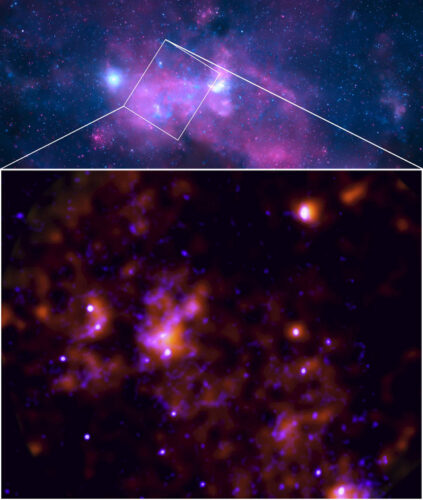
The area surrounding Sagittarius A* (Image IXPE: NASA/MSFC/F. Marin et al; Chandra: NASA/CXC/SAO; Image Processing: L.Frattare, J.Major & K.Arcand)

An article published in the journal “Nature” reports evidence that about 200 years ago, Sagittarius A*, or simply Sgr A*, the supermassive black hole at the center of the Milky Way, had a period of intense activity during which it swallowed considerable amounts of gas and dust. A team of researchers led by Frédéric Marin of the Astronomical Observatory of Strasbourg, France, used in particular data collected by the IXPE space telescope to examine the polarization of X-ray light emitted by bright large molecular clouds close to Sgr A*. The conclusion is that their out-of-normal brightness must have been due to the fact that they are reflected emissions produced by some kind of powerful and short-lived flare of the supermassive black hole that occurred about 200 years ago.

Artist impression of a black hole accretion (Image courtesy John A. Paice)

Two articles, one published in the journal “Monthly Notices of the Royal Astronomical Society” and one in “The Astrophysical Journal Letters”, report as many studies on what was defined as the largest cosmic explosion ever detected. Two teams of researchers studied the data collected with various instruments regarding the event cataloged as AT2021lwx offering two different hypotheses for its cause. Both teams believe that a supermassive black hole about 8 billion light-years from Earth caused that explosion but disagree on what triggered it: one team points to a cloud of gas and dust being violently swallowed while the other team points to a tidal disruption event where a star being devoured.

M87 with its supermassive black hole and the jet it produces (Image R.-S. Lu (SHAO), E. Ros (MPIfR), S. Dagnello (NRAO/AUI/NSF))

An article published in the journal “Nature” reports the results of the first observations ever obtained of the ring structure showing matter falling into the supermassive black hole at the center of the galaxy M87. A team of researchers used the ALMA and GLT radio telescopes and some of the ones part of the GMVA array to obtain the images they were looking for. These images show not only the area around the black hole but also the flows of materials that originate a relativistic jet. The collected data is useful to understand the mechanisms that lead those jets to reach the energies necessary to be accelerated to speeds approaching the speed of light.

The image showing the area around the supermassive black hole at the center of the galaxy M87 in the version published in 2019 and in the one reprocessed with the PRIMO system

An article published in “The Astrophysical Journal Letters” reports the results of using a machine learning system to obtain a sharper and more detailed version of the image showing the area around the supermassive black hole at the center of the galaxy M87. Lia Medeiros (Institute for Advanced Study), Dimitrios Psaltis (Georgia Tech), Tod Lauer (NOIRLab), and Feryal Özel (Georgia Tech), all members of the Event Horizon Telescope (EHT) Collaboration that obtained the image that has become famous, developed the PRIMO system to reprocess the data collected during the original observation campaign in 2017. Their aim is to obtain the maximum possible resolution with all the details present in the data collected by the various radio telescopes participating in the EHT Collaboration. The image, to which the four researchers hold the rights, shows the comparison between the famous result published in 2019 and that of the first test with PRIMO.