Blue Origin

Blogs about Blue Origin’s activities

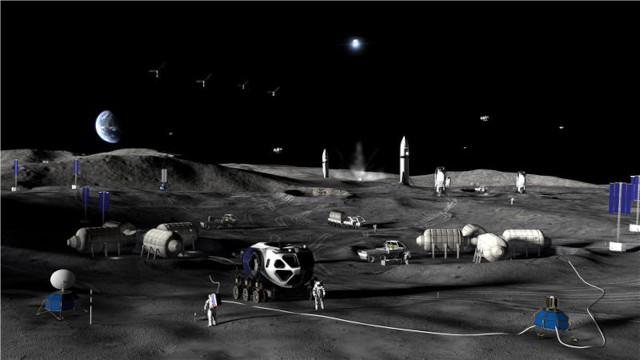
Artist's concept of the Moon base (Image NASA)

Yesterday, NASA held its Ignition event, featuring a series of announcements regarding its space program. Announcements were expected from new Administrator Jared Isaacman and other agency managers in connection with the Artemis program, to clarify the agency’s intentions regarding the return of astronauts to the Moon. From this perspective, the intention that was announced is to accelerate the pace of missions, also in order to build a permanent base on the Moon. In this new vision, the Lunar Gateway project might be abandoned, although officially, it remains relevant in the long term.

The program for missions to Mars was also part of the event. In this case, the Space Reactor-1 Freedom (SR-1 Freedom) mission was introduced, to be conducted using a spacecraft that will use nuclear electric propulsion, scheduled for launch in December 2028. A fleet of Skyfall helicopters is programmed to be on board, intended to continue exploration of the red planet.

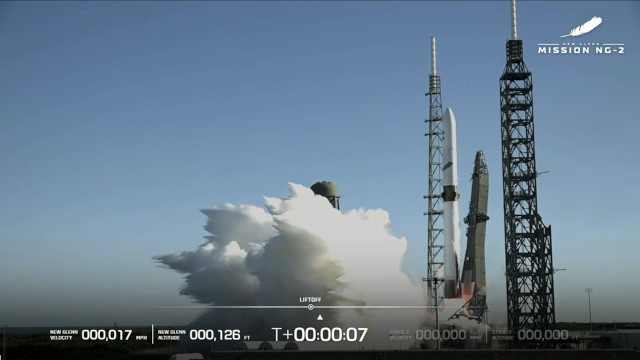
The ESCAPADE twin probes blasting off atop a New Glenn rocket (Image courtesy Blue Origin)

A few hours ago, NASA’s ESCAPADE (Escape and Plasma Acceleration and Dynamics Explorers) twin probes were launched atop a Blue Origin New Glenn rocket, which accomplished its mission, called NG-2. One goal for Blue Origin was to land the first stage, which was a successful one just over 9 minutes after launch. After approximately 33 minutes, the probes, named Blue and Gold, separated from the rocket’s second stage and began a long journey to Mars to study its magnetosphere and the Sun’s impact on the red planet.

The New Glenn rocket blasting off in its NG-1 mission (Image courtesy Blue Origin)

A little while ago, Blue Origin’s New Glenn rocket was launched on its maiden mission, called NG-1. For the occasion, it was carrying a prototype of the Blue Ring, a space platform that has the purpose of carrying payloads to be put into orbit, also under development by Blue Origin. The second stage worked correctly and the Blue Ring separated reaching the planned orbit. The secondary objective was to land the first stage, which didn’t succeed.

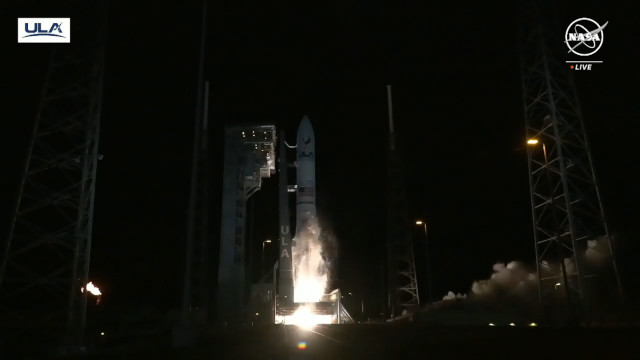
The Vulcan rocket blasting off (Image NASA TV)

A little while ago, ULA’s Vulcan rocket launched on its maiden mission, formally designated as CERT-1. For the occasion, it was carrying Astrobotic Technology’s Peregrine Moon lander, which separated from the rocket stage called Centaur after about 50 minutes. A capsule containing ashes of various famous people was also launched into a heliocentric orbit. The Centaur continued its mission with a few burns and cut-offs of its engine until it goes out of Earth orbit, scheduled after just under 4.5 hours from the launch.

The New Shepard rocket blasting off in its NS-18 flight (Image courtesy Blue Origin)

Yesterday, Blue Origin conducted the second crewed flight of its New Shepard rocket, which included actor William Shatner, famous especially for playing James Kirk in the “Star Trek” saga. The rocket blasted off from the company’s spaceport in Van Horn, Texas, and after about 3 minutes the spacecraft named “RSS First Step” separated from the rocket and reached an altitude of about 107 kilometers, more than the 100 kilometers of the Kármán Line that officially marks the boundary with space. Both the single-stage rocket and the spacecraft are reusable, so both landed at the end of the flight.