Comets

Sputnik Planitia

An article published in the journal “Icarus” describes a research that offers an explanation for the formation of the dwarf planet Pluto. A team of scientists from the Southwest Research Institute (SwRI) put together data collected by NASA’s New Horizons space probe and data collected by ESA’s Rosetta space probe, which studied comet 67P/Churyumov-Gerasimenko, concluding that Pluto formed by the union of about a billion comets similar to it.

The comet 67P/Churyumov-Gerasimenko on August 6, 2014 (Image ESA/Rosetta/MPS for OSIRIS Team MPS/UPD/LAM/IAA/SSO/INTA/UPM/DASP/IDA)

An article published in the journal “Nature Astronomy” describes a research that offers new clues about the comet 67P/Churyumov-Gerasimenko’s formation. A team led by Stephen Schwartz of the University of Côte d’Azur and the University of Arizona conducted a series of computer simulations to study the formation of comets like this one, formed by two lobes, expanding previous studies confirming them and offering an explanation to some of its characteristics.

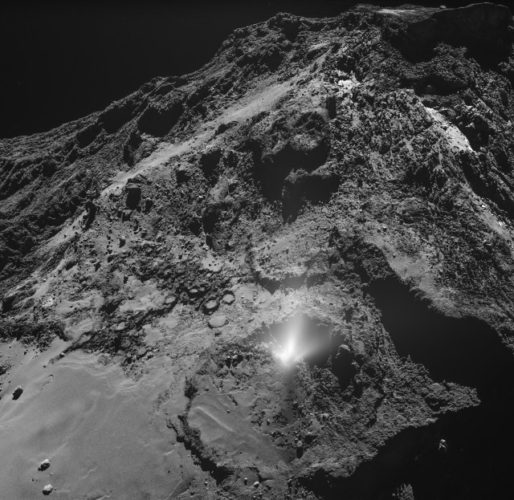
Plume on comet 67P/Churyumov-Gerasimenko (Image ESA/Rosetta/MPS for OSIRIS Team MPS/UPD/LAM/IAA/SSO/INTA/UPM/DASP/IDA)

Two articles published in the journal “Monthly Notices of the Royal Astronomical Society” describe two researches on comet 67P/Churyumov-Gerasimenko based on data collected by ESA’s Rosetta space probe. In an article, a team led by Jürgen Blum of the Technische Universität Braunschweig, Germany, used the data collected to find out how the comet formed. In the other article, a team led by Jessica Agarwal of the Max Planck Institute for Solar System Research in Göttingen, Germany, described a plume on the surface of the comet that could have been generated by pressurized underground gas or by the crystallization of amorphous water ice.

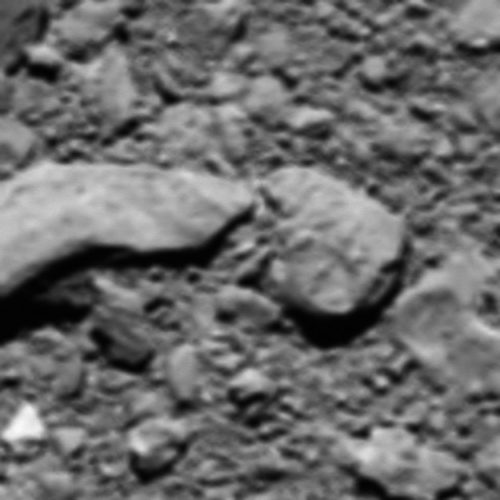
Reconstructed last image from Rosetta (Image ESA/Rosetta/MPS for OSIRIS Team MPS/UPD/LAM/IAA/SSO/INTA/UPM/DASP/IDA)

ESA has released the last image taken by its Rosetta space probe before clashing on the surface of comet 67P/Churyumov-Gerasimenko at the end of its mission along with the story of its reconstruction. The image was incomplete, so initially it wasn’t recognized as such by the automatic processing software among the packets containing telemetry data it was transmitted with.

Illustration of the method to estimate a comet's size (Image NASA/JPL-Caltech)

An article published in “The Astronomical Journal” describes a research on long-period comets concluding that they’re more common than expected. A team of researchers led by James Bauer of the University of Maryland used data collected by NASA’s WISE Space Telescope to discover that those at least one kilometer (0.6 miles) across are more common than expected and are, on average, twice as large as those of the Jupiter family.