
Cosmology

Blog about cosmology

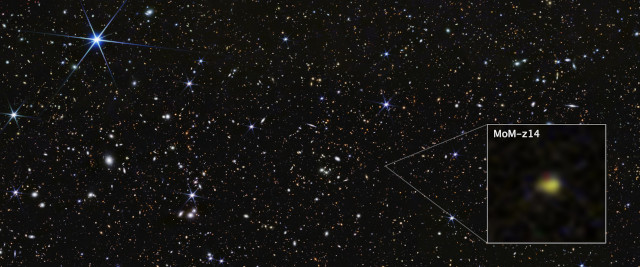
The galaxy MoM-z14 photographed by the James Webb Space Telescope's NIRCam (Near-Infrared Camera) instrument with an image from the so-called COSMOS Legacy Field in the background.

An article accepted for publication in the “Open Journal of Astrophysics” reports evidence that the galaxy MoM-z14 is the most distant known so far. A team of researchers led by the Kavli Institute for Astrophysics and Space Research at the Massachusetts Institute of Technology (MIT) used the James Webb Space Telescope as part of the “Mirage or Miracle” (MoM) survey, in which the NIRSpec instrument was used to verify the nature of very bright and potentially very distant galaxies observed in images captured by the NIRCam instrument. The results confirm that we see MoM-z14 as it was about 280 million years after the Big Bang, confirming again that highly active galaxies existed at that time.

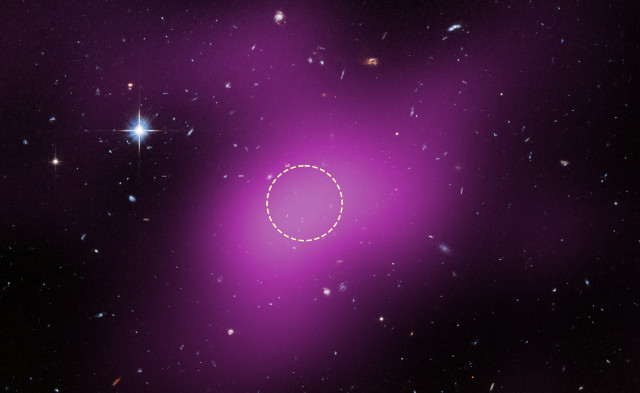
The location of Cloud-9 (Image NASA, ESA. G. Anand (STScI), and A. Benitez-Llambay (Univ. of Milan-Bicocca); Image processing: J. DePasquale (STScI))

An article published in “The Astrophysical Journal Letters” reports the discovery of what was dubbed Cloud-9, which can be described as a failed galaxy. A team of astronomers used observations with the FAST radio telescope to identify what appears to be a new type of astronomical object, and follow-up observations with the Hubble Space Telescope, the Green Bank Telescope (GBT), and the Very Large Array (VLA) to confirm the existence of the first object of its kind that was identified with reasonable certainty.

Technically defined as a reionization-limited H i cloud (RELHIC), Cloud-9 is a starless gas cloud that is supposed to be composed of dark matter filled with hydrostatic gas in thermal equilibrium with the cosmic ultraviolet background. Cloud-9 will help test cosmological models regarding dark matter.

The complete map obtained thanks to the SPHEREx space telescope, with infrared emissions generated mainly by dust (red) and hot gas (blue), key ingredients in the formation of new stars and planets

NASA has published the first cosmic map generated using observations from its SPHEREx space telescope. In particular, these observations include 102 wavelengths in the near-infrared. What NASA has defined as 102 colors offer a wealth of different information about the observed objects, valuable in a variety of cosmological studies. The wealth of information is such that NASA treats them as if they had obtained 102 different maps.

The galaxy JADES-GS-z13-1 (the red circle in the center) as seen by the James Webb Space Telescope (Image ESA/Webb, NASA, STScI, CSA, JADES Collaboration, Brant Robertson (UC Santa Cruz), Ben Johnson (CfA), Sandro Tacchella (Cambridge), Phill Cargile (CfA), J. Witstok, P. Jakobsen, A. Pagan (STScI), M. Zamani (ESA/Webb))

An article published in the journal “Nature” reports the results of observations of the primordial galaxy cataloged as JADES-GS-z13-1. A team of researchers used the James Webb Space Telescope to examine this galaxy, estimating that it dates back to about 330 million years after the Big Bang. The surprise came from spectroscopic analyses with so-called Lyman-alpha radiation, emitted in the ultraviolet by hydrogen in specific circumstances, because it was much stronger than would be expected from a galaxy of that era.

The SPHEREx space telescope and the PUNCH satellites blasting off atop a Falcon 9 rocket (Image courtesy SpaceX)

A few hours ago, the SPHEREx space telescope and the PUNCH satellites, two NASA astronomy missions, blasted off atop a SpaceX Falcon 9 rocket from the Vandenberg base. After about 42 minutes, SPHEREx successfully separated from the rocket’s last stage, and about 10 minutes later, the PUNCH satellites also separated, within about a minute. Both missions will operate from a Sun-synchronous orbit at an altitude of 700 kilometers for SPHEREx and 570 kilometers for PUNCH.