
Cosmology

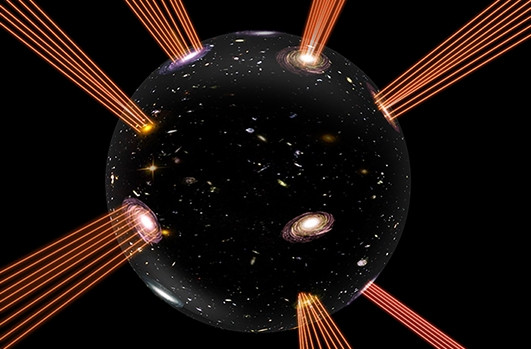
Artist's concept of the universe on a 5D bubble (Image courtesy Suvendu Giri)

An article published in the journal “Physical Review Letters” describes a new model of the universe that proposes that it exists on the edge of an expanding bubble in a five-dimension space-time. A team of researchers from the Swedish University of Uppsala used string theory to hypothesize that the matter existing in the universe is accomodated at the edges of strings that extend into the fifth dimension. According to this hypothesis, what is called dark energy is an effect described by a cosmological constant in the four-dimension Friedmann equations.

The Abell S1063 galaxy cluster (Image NASA, ESA, and M. Montes (University of New South Wales, Sydney, Australia))

An article published in the journal “Monthly Notices of the Royal Astronomical Society” describes a new method to detect and map the dark matter existing in galaxy clusters with a higher precision than those used so far. Mireia Montes of the University of New South Wales, Australia, and Ignacio Trujillo of the Canary Islands Institute of Astronomy, Spain, exploited the so-called intracluster light, the faint light within galaxy clusters produced by their interaction, detected in the Hubble Frontier Fields program, to map the distribution of dark matter within them.

Some ASKAP antennas with the Milky Way overhead (Image courtesy Alex Cherney/CSIRO. All rights reserved)

An article published in the journal “Nature” reports the results of a survey on Fast Radio Bursts (FRBs), intense radio emissions from other galaxies. A team of researchers used the Australia Square Kilometer Array Pathfinder (ASKAP) radio telescope to search for Fast Radio Bursts discovering 20 in a year, almost doubling the number previously detected. Their analysis suggests that their characteristics evolve over time.

A possible pulsar formed after a long-duration supernova

An article published in the “Astrophysical Journal Letters” describes a study on the supernova Sn 2012au. Sometimes supernovae remain bright for a long time if the remnants of the explosion collide with hydrogen layers, but Dan Milisavljevic of Purdue University wondered if this could happen without any interaction of that kind. His team studied Sn 2012au concluding that after the supernova a neutron star of the pulsar type was formed with a rotation and a magnetic field sufficient to create a cloud of gas around it, called in jargon a pulsar wind nebula.

A relativistic jet after the kilonova

An article published in the journal “Nature” describes the observations of a relativistic jet that followed the merger between two neutron stars discovered in August 2017, the first case of an event detected and studied in both electromagnetic and gravitational waves. A team of researchers used the precise measurements made with some radio telescopes to establish that a narrow jet of particles was emitted at a speed close to that of light after the event.