Cosmology

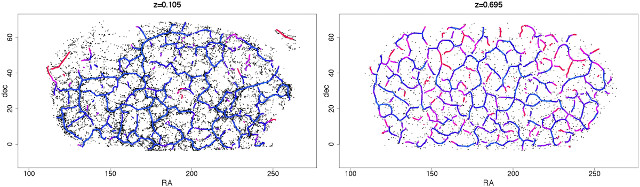
The cosmic web in two moments

An article published in the journal “Nature Astronomy” describes the creation of a map of the network of filaments that connects matter all around the universe. A team of researchers analyzed the data collected during previous surveys to find the gravitational effects that reveal the shapes of those filaments. Those small gravitational distortions suggest that they’re hundreds of millions of light years long and that they’re made of dark matter.

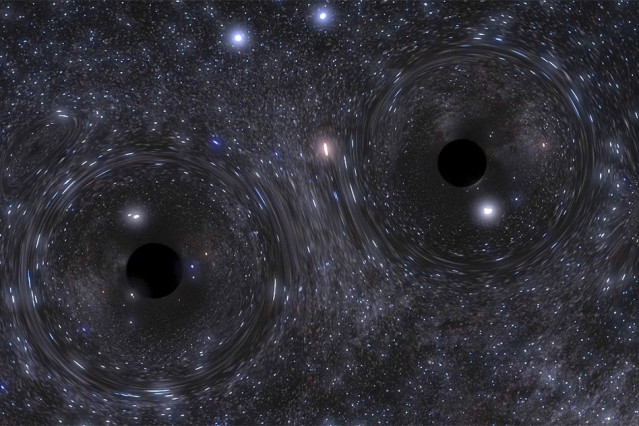
A snapshot of a simulation showing a binary black hole (Image courtesy Northwestern Visualization/Carl Rodriguez. All rights reserved)

An article published in the journal “Physical Review Letters” describes the simulations of the evolution of globular clusters of the type commonly found in galaxies to assess the possibility of black holes mergers. A team led by MIT astrophysicist Carl Rodriguez used the Quest supercomputer at Northwestern University to simulate 24 clusters with different characteristics, also calculating relativistic effects, concluding that repeated mergers can occur, forming black holes more massive than the stellar ones.

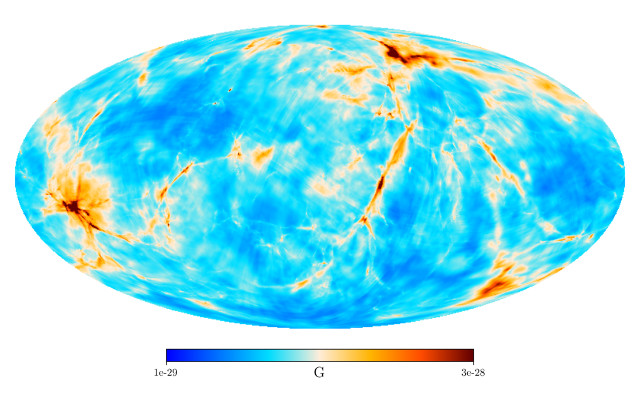
Magnetic Field Map (Image courtesy MPI for Astrophysics, All rights reserved)

An article published in the journal “Classical and Quantum Gravity” describes the reconstruction of the map of magnetic fields generated after the Big Bang in the “cosmic neighborhood”. A team of researchers used an algorithm called BORG (Bayesian Origin Reconstruction from Galaxies), developed to work on large-scale structures, to data from the 2M++ galaxy catalog to calculate how these magnetic fields should look like today within a radius of 300 million of light years around the Earth.

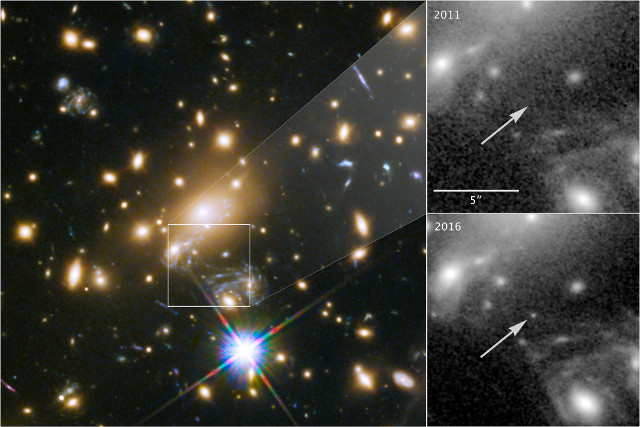
Icarus (MACS J1149+2223 Lensed Star 1)

An article published in the journal “Nature Astronomy” describes the observation of the most distant star and therefore also the oldest observed so far, nicknamed Icarus, about 9 billion light years from Earth. A team of researchers exploited a double gravitational lensing effect that magnified the image of the star, which was called MACS J1149+2223 Lensed Star 1 but for that reason it’s simply called Lensed Star 1 (LS1). That effect made it become bright enough to be detectable by the Hubble Space Telescope.

The galaxy NGC 1052-DF2 (Image NASA, ESA, and P. van Dokkum (Yale University))

An article published in the journal “Nature” describes a research on the ultra-diffuse galaxy NGC 1052-DF2. A team of researchers led by Pieter van Dokkum of Yale University, used a number of telescopes to observe this galaxy’s composition concluding that it contains a very low amount of dark matter. The gravitational effects detected in the galaxies show that generally they contain an amount of dark matter much higher than that of ordinary matter but NGC 1052-DF2 is an exception and therefore must be carefully studied.