
Dark matter

Blogs about dark matter

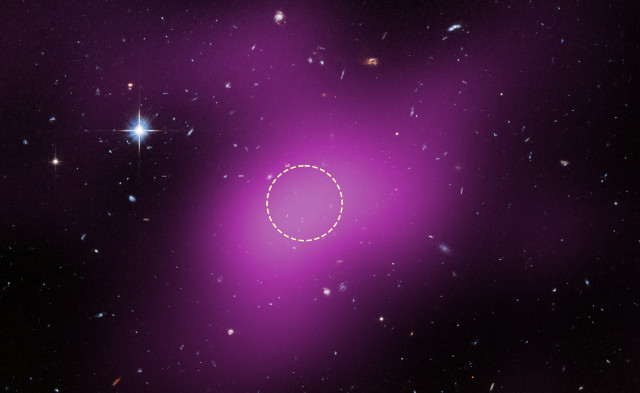
The location of Cloud-9 (Image NASA, ESA. G. Anand (STScI), and A. Benitez-Llambay (Univ. of Milan-Bicocca); Image processing: J. DePasquale (STScI))

An article published in “The Astrophysical Journal Letters” reports the discovery of what was dubbed Cloud-9, which can be described as a failed galaxy. A team of astronomers used observations with the FAST radio telescope to identify what appears to be a new type of astronomical object, and follow-up observations with the Hubble Space Telescope, the Green Bank Telescope (GBT), and the Very Large Array (VLA) to confirm the existence of the first object of its kind that was identified with reasonable certainty.

Technically defined as a reionization-limited H i cloud (RELHIC), Cloud-9 is a starless gas cloud that is supposed to be composed of dark matter filled with hydrostatic gas in thermal equilibrium with the cosmic ultraviolet background. Cloud-9 will help test cosmological models regarding dark matter.

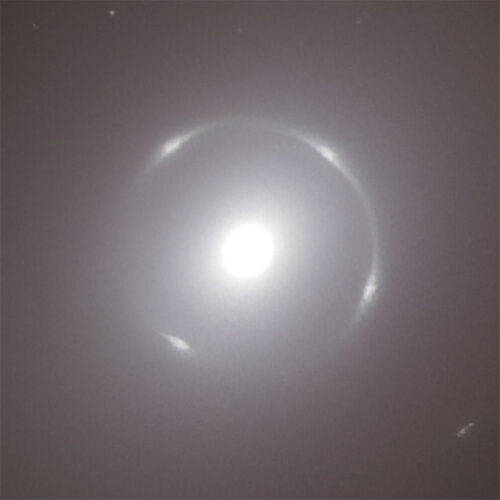
The Einstein ring around galaxy NGC 6505 (Image ESA/Euclid/Euclid Consortium/NASA, image processing by J.-C. Cuillandre, G. Anselmi, T. Li / CC BY-SA 3.0 IGO)

An article published in the journal “Astronomy & Astrophysics” reports the identification of a practically perfect so-called Einstein ring around the galaxy NGC 6505. A team of researchers Conor led by O’Riordan of the Max Planck Institute for Astrophysics in Munich, Germany, examined observations conducted with the Euclid space telescope to study the image of a much more distant galaxy distorted by the gravitational lens created by NGC 6505. This effect allows to study NGC 6505 as well because its mass creates that gravitational lens, so its effects allow to analyze it.

The ultramassive galaxies S1, S2, and S3

An article published in the journal “Nature” reports the discovery of three ultramassive galaxies in the early universe in which stars are forming with an efficiency almost twice that of galaxies of average mass by the standards of that era. A team of researchers coordinated by the University of Geneva (UNIGE) used observations conducted with the James Webb space telescope within the FRESCO program. The three galaxies (Image NASA/CSA/ESA, M. Xiao & P. ​​A. Oesch (University of Geneva), G. Brammer (Niels Bohr Institute), Dawn JWST Archive), which were cataloged as S1, S2, and S3, are almost as massive as the Milky Way and add to others that were discovered in recent years and are difficult to explain with the most accepted cosmological models, starting with lambda-CDM.

Protogalaxies as seen by the James Webb Space Telescope (Image NASA)

An article published in “The Astrophysical Journal” reports some predictions offered by MOND (Modified Newtonian Dynamics), a theory based on modifications to Newton and Einstein’s gravitational laws that doesn’t include the existence of dark matter. Stacy S. McGaugh, James M. Schombert, Federico Lelli, and Jay Franck have applied this model to primordial galaxies studied with the James Webb Space Telescope obtaining a better agreement than the lambda-CDM model, the best cosmological model based on the existence of dark matter. This is one of the studies, often based on Webb’s observations, that are testing cosmological models that weren’t considered very much due to the lack of confirmation.

Coma Cluster (Image CTIO/NOIRLab/DOE/NSF/AURA. Image Processing: D. de Martin & M. Zamani (NSF NOIRLab)

An image captured by the Dark Energy Camera (DECam) depicts the Coma Cluster, also known as Abell 1656, so named because it’s part of the constellation Coma Berenices. DECam was designed to conduct a long-term investigation of dark energy but is also useful for other types of astronomical studies. The Coma Cluster is linked to the study of dark matter since the inconsistency between the estimate of its overall mass and the measurement of its gravitational effects stimulated the research that led to today’s dark matter models.