Dark matter

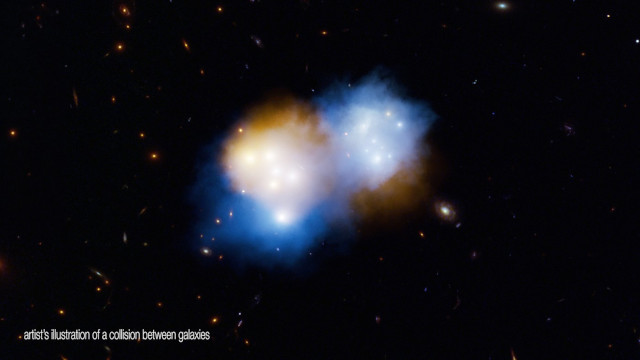
Artist's concept of MACS J0018.5 with dark matter in blue and baryonic matter in orange (Image courtesy W.M. Keck Observatory/Adam Makarenko)

An article published in the journal “The Astrophysical Journal” reports the results of a study on the ongoing merger between two galaxy clusters that are forming a single new cluster cataloged as MACS J0018.5+1626, or simply MACS J0018.5. A team of researchers used data obtained from observations dating back even decades conducted with various space and ground-based telescopes, analyzing them to decouple the behavior of ordinary matter and dark matter.

To measure the speed of intergalactic gas composed of normal matter, they used the kinematic Sunyaev-Zel’dovich (SZ) effect. The speed of dark matter is roughly the same as galaxies. The result is that dark matter moves faster than normal matter. This result offers clues about dark matter and its behavior that are useful in studies of its nature.

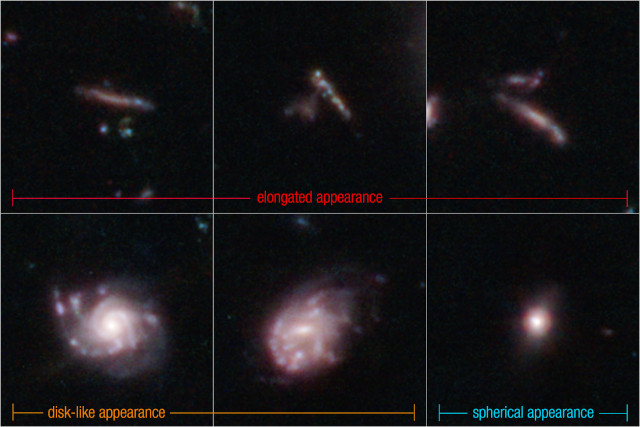
Some examples of the galaxies observed during the Cosmic Evolution Early Release Science (CEERS) survey

An article in publication in “The Astrophysical Journal” reports the results of observations of early galaxies that show strange shapes, decidedly different from the ones we’re used to and compared to bananas and even breadsticks. A team of researchers led by Viraj Pandya of Columbia University used observations conducted with the James Webb Space Telescope as part of the CEERS survey from which they obtained images of galaxies dating back to a period between 600 million and 6 billion years after the Big Bang.

The Perseus galaxy cluster (Image ESA/Euclid/Euclid Consortium/NASA, image processing by J.-C. Cuillandre (CEA Paris-Saclay), G. Anselmi, CC BY-SA 3.0 IGO)

ESA has presented the first official images captured by its Euclid space telescope. After some delays due to problems with the fine guidance sensor, it was possible to calibrate Euclid’s instruments and obtain the extraordinary precision of observations necessary for its mission. The result is a resolution that allows a quantity of detail never seen before to be included in the images, be it galaxies, stars, or other objects, often discovered by Euclid. The presentation showed the results both with distant objects such as the Perseus galaxy cluster and with others close in astronomical terms such as the Horsehead Nebula.

A diagram illustrating the combined power of the James Webb and Hubble space telescopes in studying Cepheids present in the galaxy NGC 5584 with the NIRCam (Near-Infrared Camera) and WFC3 (Wide Field Camera 3) instruments, respectively

An article accepted for publication in “The Astrophysical Journal” reports the results of calculating the universe’s expansion rate based on the observation of Cepheids with the James Webb Space Telescope. In particular, a team of researchers led by Adam Riess used the NIRCam instrument to observe over 330 cepheids in the galaxies NGC 4258 and NGC 5584. The results are more precise than those obtained in the past with the Hubble Space Telescope but confirm the accuracy of the previous calculation of the universe’s expansion rate. This leaves open the question of the difference in results obtained with different methods.

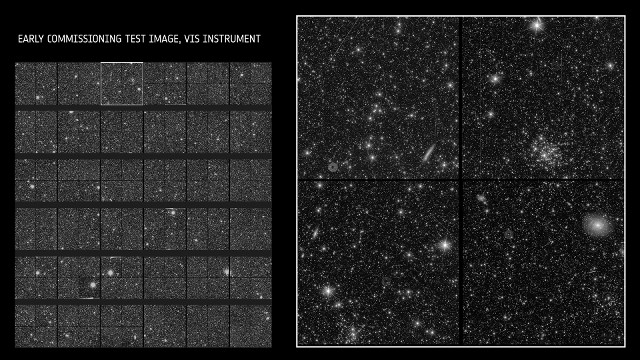
Early commissioning test image – VIS instrument full field of view and zoom in for detail

ESA has published the first test images captured by the Euclid Space Telescope. As soon as Euclid reached its destination, testing of both instruments, VIS and NISP, began and will continue for a couple of months to calibrate them until they reach optimal performance. They are necessary tasks to enable Euclid to conduct the scientific mission which consists of investigating the dark universe to try to solve some cosmological mysteries such as that of the acceleration of the universe expansion.