Dark matter

JADES-GS-z13-0, JADES-GS-z12-0, and JADES-GS-z11-0

An article published in the journal “Proceedings of the National Academy of Sciences” reports the discovery of candidate supermassive dark stars observed by the James Webb Space Telescope. Cosmin Ilie, Jillian Paulin, and Katherine Freese argue that three of what were considered primordial galaxies have characteristics of a type of object that so far was only hypothesized. According to the model proposed in 2007, supermassive dark stars have a large dark matter component that powers them instead of nuclear fusion. These strange objects could reach masses up to ten million times the Sun’s and a brightness up to ten billion times the Sun’s, which could lead to mistaking them for primordial galaxies.

The Euclid Space Telescope blasting off atop a Falcon 9 rocket (Image courtesy SpaceX)

A little while ago, ESA’s Euclid Space Telescope was launched atop a SpaceX Falcon 9 rocket from Cape Canaveral. After just over 40 minutes, it successfully separated from the rocket’s last stage and entered its course that will take it towards the so-called L2 point, about 1.5 million kilometers from Earth, where its scientific mission will begin with an investigation of the dark universe.

The Euclid Space Telescope mission is focused on the cosmological mysteries connected to dark matter and dark energy. Cosmological research in recent decades indicates that the universe we see with the ordinary matter that forms galaxies constitutes only a small part of the cosmos. Astronomers and physicists are having difficulty investigating parts of the cosmos that we can neither see nor directly detect. It’s a problem that makes it difficult to test models that try to explain the effects that led to hypothesize the existence of dark matter and dark energy. For this reason, ESA developed a scientific mission focused on these cosmological problems.

The galaxy cluster Abell 2744 and its surrounding area, including the views distorted by gravitational lensing of galaxies behind it. Among them are the seven galaxies identified in the A2744-z7p9OD protocluster, also seen in the insets.

An article published in “The Astrophysical Journal Letters” reports the evidence for the discovery of the oldest galaxy protocluster known so far. A team of researchers led by Takahiro Morishita of Caltech identified the cluster in its formation phase which was cataloged as A2744-z7p9OD with the Hubble Space Telescope and then confirmed with the James Webb Space Telescope the presence of at least seven galaxies. They were forming a larger structure about 650 million years after the Big Bang and according to calculations, the cluster has grown over time to include many other galaxies.

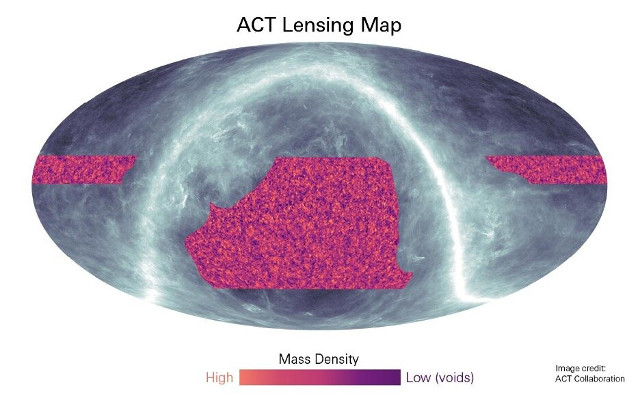
The map of dark matter based on observations from the Atacama Cosmology Telescope

During the Future Science with CMB x LSS conference underway at Kyoto University, Japan, the results of a detailed mapping of dark matter in a part of the universe were presented. Three articles available in preview and submitted to “The Astrophysical Journal” illustrate these results, obtained using observations conducted at the Atacama Cosmology Telescope (ACT) in Chile, which operated between 2007 and 2022. This map (Image courtesy ACT Collaboration) was obtained by analyzing the cosmic microwave background radiation and its deviations caused to the gravity of massive structures such as concentrations of dark matter.

The galaxy clusters MOO J1014+0038 (left panel) and SPT-CL J2106-5844 (right panel) as seen by the Hubble Space Telescope's Wide Field Camera 3 instrument at infrareds

An article published in the journal “Nature” reports the results of a study on the so-called intracluster light that permeates galaxy clusters. Hyungjin Joo and M. James JeeĀ of Yonsei University in Seoul, South Korea, used the Hubble Space Telescope to examine ten galaxy clusters and the glow within them. The surprising and therefore interesting discovery was that intracluster light is abundant even in the oldest clusters, a sign that the stars that emit it were ejected from their galaxies a long time ago. This suggests that this happened at the same time as the formation and growth of the clusters.