Dark matter

The SMACS-J0723.3-7327 galaxy cluster seen by the James Webb Space Telescope

An article published in “The Astrophysical Journal Letters” reports the results of the most complete analysis of the so-called intracluster light conducted so far. Mireia Montes and Ignacio Trujillo of the Instituto de Astrofísica de Canarias (IAC) used the James Webb Space Telescope to observe the SMACS-J0723.3-7327 galaxy cluster. In particular, they exploited the NIRCam instrument to detect intracluster light, which is extremely dim but useful to study galaxy clusters in ways other than visible light observations. These studies are also useful for understanding the distribution of dark matter.

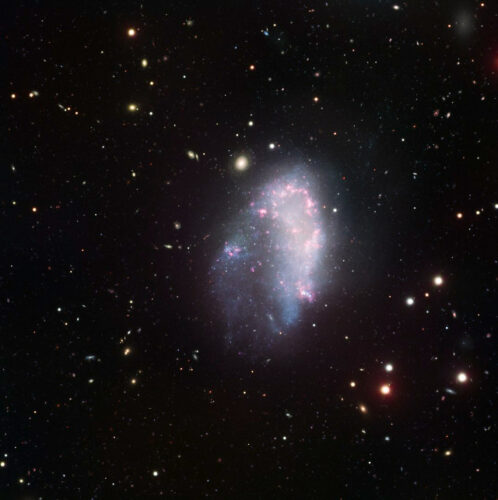
NGC 1427A, one of the dwarf galaxies in the Fornax cluster that appear to be devoid of dark matter halos (Image ESO)

An article published in the journal “Monthly Notices of the Royal Astronomical Society” reports the results of a study of the distribution and morphology of the dwarf galaxies of the Fornax cluster which concludes that they are free of dark matter halos. A team of researchers coordinated by the German University of Bonn and the Scottish University of Saint Andrews examined those dwarf galaxies to see how perturbed they are by gravitational tides generated by nearby galaxies.

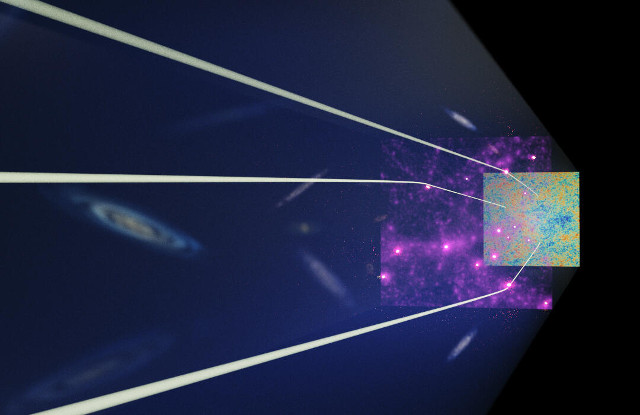
An artistic representation of the combination of the observations obtained in the HSC-SSP survey and the cosmic microwave background data collected by the Planck Surveyor space probe

An article published in the journal “Physical Review Letters” reports the results of an analysis of dark matter distribution around 1.5 million primordial galaxies. A team of researchers led by Hironao Miyatake of the Japanese University of Nagoya used observations conducted with the Subaru telescope and analyzed data collected by the Planck Surveyor space probe to detect distortion of the cosmic microwave background (CMB).

The results of this study show fluctuations in dark matter distribution in the early universe that led to inhomogeneity in the aggregation of ordinary matter that formed galaxies. That aggregation is lower than predicted by the Lambda-CDM model, the one that currently best describes the observations. The uncertainty lies in the difficulty of obtaining precise results in examining very distant galaxies.

The ultra-faint dwarf galaxy Pegasus V

An article submitted for publication in the journal “Monthly Notices of the Royal Astronomical Society” reports the identification of an ultra-faint dwarf galaxy that was named Pegasus V near the Andromeda galaxy. A team of researchers conducted follow-up observations following the discovery made by an amateur astronomer and, using the GMOS instrument mounted on the Gemini North telescope in Hawaii, confirmed its existence. An interesting result of the observations is the very limited presence of elements heavier than hydrogen and helium, a discovery that led to the conclusion that it’s a kind of fossil of a primordial galaxy.

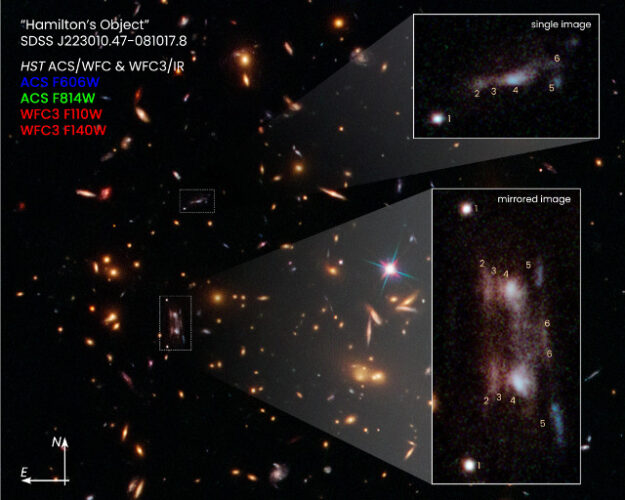
Hamilton's Object seen by Hubble

An article published in the journal “The Monthly Notices of the Royal Astronomical Society” reports a solution to an astronomical mystery involving two galaxies that appeared to be mirror images of each other and turned out to be two images of the same galaxy doubled by a gravitational lens. A team of researchers led by Richard Griffiths of the University of Hawaii at Hilo used observations made with the Hubble Space Telescope to obtain enough information to understand the nature of what was named Hamilton’s Object because it was discovered by astronomer Timothy Hamilton. Meanwhile, a third image of the galaxy was discovered, visible in another area of ​​the sky again thanks to the gravitational lens.