Dark matter

A measurement of the Hubble constant based on quasars suggests possible changes to cosmological models

An article published in the journal “Nature Astronomy” describes the use of quasars as cosmic tracers to measure the expansion of the universe up to 12 billion years ago. Guido Risaliti of the University of Florence and Elisabeta Lusso of Durham University studied the X-ray and optical emissions of a number of quasars using the comparison between those emissions to accurately assess their distances. The results could explain the discrepancies between the different measurements carried out with other methods suggesting that the density of the mysterious dark energy isn’t constant over time.

A verification of dark matter heating

An article published in the journal “Monthly Notices of the Royal Astronomical Society” reports confirmations to the hypothesis of the effect known as dark matter heating. A team of researchers looked for the effects of the presence of dark matter in dwarf galaxies relatively close to the Milky Way, finding the confirmation that star formation can heat it causing it to move outwards. It’s a new possibility to study dark matter to try to understand its nature.

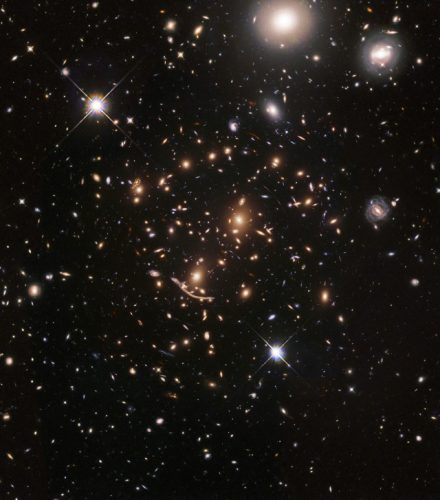
The Abell S1063 galaxy cluster (Image NASA, ESA, and M. Montes (University of New South Wales, Sydney, Australia))

An article published in the journal “Monthly Notices of the Royal Astronomical Society” describes a new method to detect and map the dark matter existing in galaxy clusters with a higher precision than those used so far. Mireia Montes of the University of New South Wales, Australia, and Ignacio Trujillo of the Canary Islands Institute of Astronomy, Spain, exploited the so-called intracluster light, the faint light within galaxy clusters produced by their interaction, detected in the Hubble Frontier Fields program, to map the distribution of dark matter within them.

The galaxy cluster Abell 370 (Image NASA, ESA, A. Koekemoer, M. Jauzac, C. Steinhardt, and the BUFFALO team)

The first Hubble Space Telescope’s observations in the new BUFFALO project have been published. Its goal is to shed light on the evolution of the first galaxies of the universe, also to establish the most interesting observation targets for the James Webb space telescope. The Abell 370 galaxy cluster is the first to be studied for this new survey together with a series of galaxies seen through gravitational lenses.

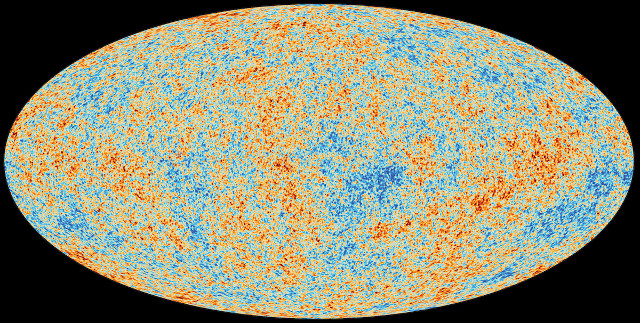
CMB Final Map (Image ESA/Planck Collaboration)

ESA presented the final map of the cosmic microwave background radiation created thanks to the Planck Surveyor space probe. This map shows what the universe was like before galaxies formed when it was about 380,000 years old. These are the results of the last processing of the collected data and now scientists are certain that the temperature and polarization are accurately determined. This final map confirms the standard model but also the inconsistency between the calculation of the Hubble constant based on those data and the one based on observation of the current universe.