Dark matter

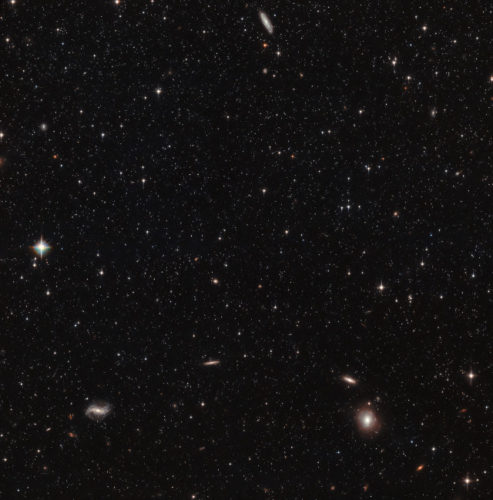
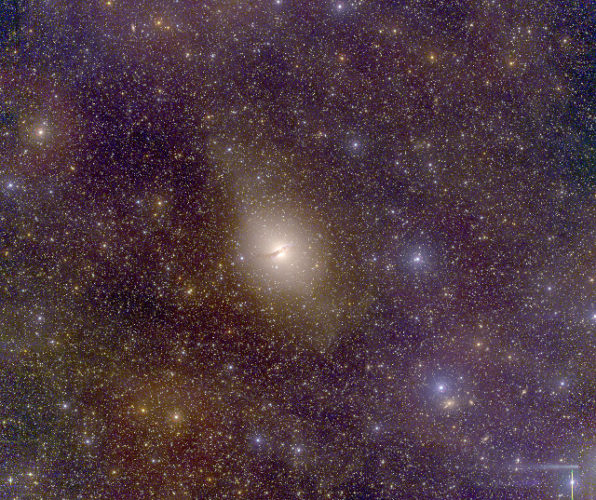
Centaurus A and its dwarf satellite galaxies (Image Christian Wolf and the SkyMapper team / Australian National University)

An article published in the journal “Science” describes a research that shows what appears to be a discrepancy between the observations of a group of galaxies and the current models about dark matter. A team of astronomers determined that 14 of the 16 dwarf satellite galaxies of the Centaurus A galaxy follow a common movement pattern and are arranged on a plane instead of moving in a chaotic way with a random arrangement around the central galaxy.

El Gordo (Image ESA/Hubble & NASA, RELICS)

A photo of the galaxy cluster ACT-CL J0102-4915 captured by the Hubble Space Telescope provides a small idea of ​​the vastness of this set of galaxies that has a total mass estimated at 3 million billion times the Sun’s. For this reason it’s been nicknamed “El Gordo”, which in Spanish means “the fat one”. It intensly emits X-rays and that’s another reason of interest for astronomers that led to observe it, discovering that it’s actually formed by two smaller – or less enormous – galaxy clusters that collided.

A part of the Sculptor Dwarf Galaxy (Image ESA/Hubble & NASA)

An article published in the journal “Nature Astronomy” reports the reconstruction of the 3D movements of 10 stars in the Sculptor Dwarf Galaxy selected within a larger sample of over 100 among those with the smallest measurement errors. A team of researchers used observations made using the Hubble Space Telescope in 2002 and subsequent observations carried out by ESA’s Gaia space probe between 2014 and 2015 to produce this reconstruction that confirms the “cold” dark matter model.

Dark Energy Survey's map (Image Chihway Chang/Kavli Institute for Cosmological Physics at the University of Chicago/DES Collaboration)

The Dark Energy Survey (DES) collaboration presented a map of dark matter at the American Physical Society Division of Particles and Fields at Fermilab created using gravitational lensing effects from 26 million galaxies. These results show the composition of the recent universe and are very close to the predictions based on the map created upon measurements the primeval universe of ESA’s Planck Surveyor satellite.

Example of galaxy pair connected by dark matter filaments (Image courtesy S. Epps & M. Hudson / University of Waterloo)

An article published in the journal “Monthly Notices of the Royal Astronomical Society” describes a research on dark matter filaments that connect two galaxies. A team of astronomers led by Mike Hudson of the University of Waterloo in Canada exploited a weak gravitational lensing effect to create an image that shows even if indirectly a kind of dark matter bridge between two galaxies.