ESA

Greeley Crater (Image ESA/DLR/FU Berlin, CC BY-SA 3.0 IGO)

New images captured by ESA’s Mars Express space probe’s High Resolution Stereo Camera (HRSC) show Greeley Crater on Mars. Its name was officially approved in 2015 by the International Astronomical Union (IAU) to honor geologist Ronald Greeley, who passed away in 2011 after having worked on various Mars missions, also being part of the team that manages the HRSC instrument.

BepiColombo's space probe blasting off atop an Ariane 5 rocket (Photo courtesy ESA-CNES-Arianespace)

A few hours ago the two space probes of ESA and JAXA’s BepiColombo mission blasted off on an Ariane 5 ECA rocket from the Kourou base in French Guiana. Almost 27 minutes after launch, the spacecraft regularly separated from the rocket’s last stage along with the Mercury Transfer Module (MTM), which will provide the propulsion through its ion engines to transport the probes to the planet Mercury.

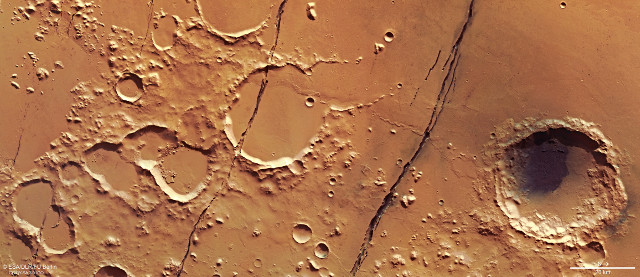
The Cerberus Fossae (Image ESA/DLR/FU Berlin, CC BY-SA 3.0 IGO)

ESA has published photos taken by its Mars Express space probe of the Cerberus Fossae, fractures that run almost parallel for more than 1,000 kilometers in the area near the equator of the planet Mars. They’re part of a large volcanic complex called Elysium Planitia, where traces suggest that lava flows date back a few million years ago, recent in geological terms compared to the bulk of volcanic activity. The Cerberus Fossae were also formed relatively recently, less than 10 million years ago, probably originated from faults that stretched the upper layers of the surface apart.

Mars Express detections at Mars South Pole

An article published in the journal “Science” describes the discovery of an underground lake of liquid water on Mars. A team of researchers led by Roberto Orosei of the National Institute of Astrophysics and composed of researchers belonging to Italian research centers and universities used data collected by ESA’s Mars Express space probe’s MARSIS radar to collect evidence that at the south pole at about 1.5 kilometers of depth there’s water that is liquid.