ESA

The Sentinel-5P satellite blasting off atop a Rockot vehicle (Photo ESA)

A few hours ago, the Sentinel-5P satellite of the Copernicus / GMES program, blasted off from the Plesetsk Cosmodrome, Russia, on a Rockot with a Briz-KM upper stage rocket. The satellite regularly separated from the rocket’s last stage and after about an hour and a half started sending signals.

The Sentinel-5P – where “P” stands for Precursor – satellite is the first of the Copernicus constellation devoted to atmospheric monitoring. The term Precursor is due to the fact that it’s the forerunner of the future Sentinel-5 satellite and represents a step forward compared to Envisat. It will complement the EUMETSAT’s MetOp meteorological satellites and work in coordination with the Suomi-NPP American mission, which began in 2011 with similar aims.

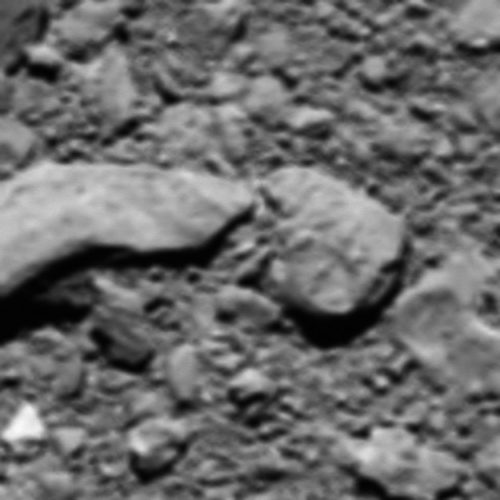
Reconstructed last image from Rosetta (Image ESA/Rosetta/MPS for OSIRIS Team MPS/UPD/LAM/IAA/SSO/INTA/UPM/DASP/IDA)

ESA has released the last image taken by its Rosetta space probe before clashing on the surface of comet 67P/Churyumov-Gerasimenko at the end of its mission along with the story of its reconstruction. The image was incomplete, so initially it wasn’t recognized as such by the automatic processing software among the packets containing telemetry data it was transmitted with.

Crater north of Hellas Planitia (Image ESA/DLR/FU Berlin, CC BY-SA 3.0 IGO)

ESA has published some images of a crater with more than 30 kilometers (about 20 miles) across north of the large Hellas Planitia basin on the planet Mars obtained thanks to the High Resolution Stereo Camera (HRSC) instrument of the Mars Express space probe. The appearance of the crater along with the river valleys to the south indicates that at the time of impact there was groundwater near the surface. This is another indication that there was a lake in that region.

The last pictures of Saturn's rings taken by the Cassini space probe (Image NASA/JPL)

NASA has confirmed that it has lost contact with the Cassini space probe, which until the last moment was sending information as it descended into the atmosphere of the planet Saturn and went to its destruction. It’s the end of the Cassini-Huygens mission, a collaboration between NASA, ESA and ASI (Italian Space Agency), one of the most extraordinary space missions in history.

Thaumasia mountains and Coracis Fossae (Image ESA/DLR/FU Berlin, CC BY-SA 3.0 IGO)

ESA has released some photos taken by its Mars Express space probe showing an area of ​​the Thaumasia mountains and Coracis Fossae on Mars. This area is south of the gigantic canyon system called Valles Marineris and of Tharsis volcanoes and shows traces of the activity that led to their formation more than 3.5 billion years ago. The result is a variety of features with mountains and graben.