ESA

Fractures in the Sirenum Fossae (Image ESA/DLR/FU Berlin, CC BY-SA 3.0 IGO)

ESA has released images captured by its Mars Express space probe that show the Mars area called Sirenum Fossae. The High Resolution Camera Stereo Camera (HRSC) camera allowed to take photos of an area whose appearance was determined by an ancient volcanic activity, with the result that a system of tectonic faults called graben in jargon stretched for thousands of kilometers on the red planet’s surface.

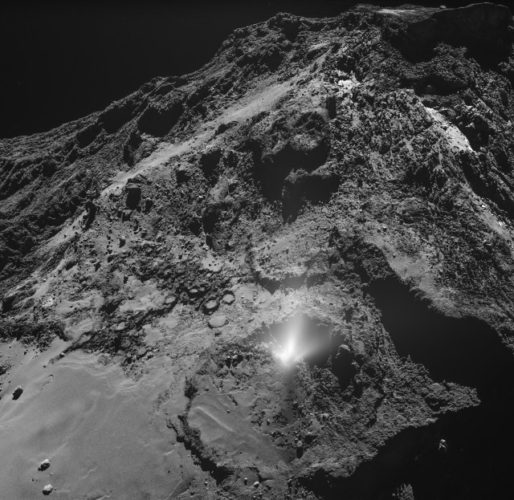
Plume on comet 67P/Churyumov-Gerasimenko (Image ESA/Rosetta/MPS for OSIRIS Team MPS/UPD/LAM/IAA/SSO/INTA/UPM/DASP/IDA)

Two articles published in the journal “Monthly Notices of the Royal Astronomical Society” describe two researches on comet 67P/Churyumov-Gerasimenko based on data collected by ESA’s Rosetta space probe. In an article, a team led by Jürgen Blum of the Technische Universität Braunschweig, Germany, used the data collected to find out how the comet formed. In the other article, a team led by Jessica Agarwal of the Max Planck Institute for Solar System Research in Göttingen, Germany, described a plume on the surface of the comet that could have been generated by pressurized underground gas or by the crystallization of amorphous water ice.

The Sentinel-5P satellite blasting off atop a Rockot vehicle (Photo ESA)

A few hours ago, the Sentinel-5P satellite of the Copernicus / GMES program, blasted off from the Plesetsk Cosmodrome, Russia, on a Rockot with a Briz-KM upper stage rocket. The satellite regularly separated from the rocket’s last stage and after about an hour and a half started sending signals.

The Sentinel-5P – where “P” stands for Precursor – satellite is the first of the Copernicus constellation devoted to atmospheric monitoring. The term Precursor is due to the fact that it’s the forerunner of the future Sentinel-5 satellite and represents a step forward compared to Envisat. It will complement the EUMETSAT’s MetOp meteorological satellites and work in coordination with the Suomi-NPP American mission, which began in 2011 with similar aims.

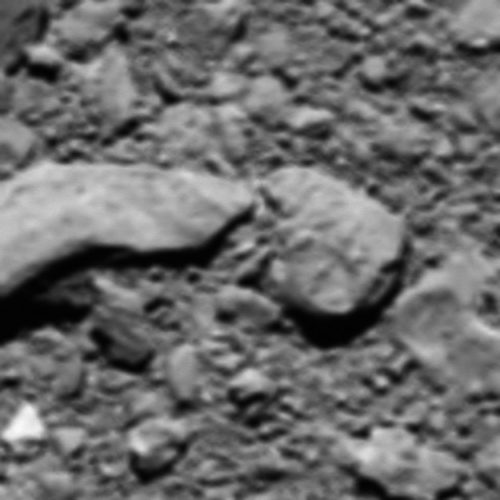
Reconstructed last image from Rosetta (Image ESA/Rosetta/MPS for OSIRIS Team MPS/UPD/LAM/IAA/SSO/INTA/UPM/DASP/IDA)

ESA has released the last image taken by its Rosetta space probe before clashing on the surface of comet 67P/Churyumov-Gerasimenko at the end of its mission along with the story of its reconstruction. The image was incomplete, so initially it wasn’t recognized as such by the automatic processing software among the packets containing telemetry data it was transmitted with.