ESO

Artistic concept of Proxima b's surface. In the upper-right of Proxima Centauri there are Alpha Centauri A and B (Image ESO/M. Kornmesser)

Yesterday ESO held a press conference to announce that probably they discovered an exoplanet orbiting Proxima Centauri, the nearest star to the solar system. A team of astronomers led by Guillem Anglada-Escudé from Queen Mary University of London found what was called Proxima b, a planet a little more massive than the Earth orbiting in the habitable zone of its star.

Artistic concept of the V883 Orionis system with its protoplanetary disc and the snow in it (Image A. Angelich (NRAO/AUI/NSF)/ALMA (ESO/NAOJ/NRAO))

An article published in the journal “Nature” describes the first observation ever of the water snow line in the V883 Orionis system. Using the ALMA radio telescope, a team led by Lucas Cieza of the Universidad Diego Portales, Santiago, Chile, identified the distance from the star beyond which the temperature drops enough for water to freeze.

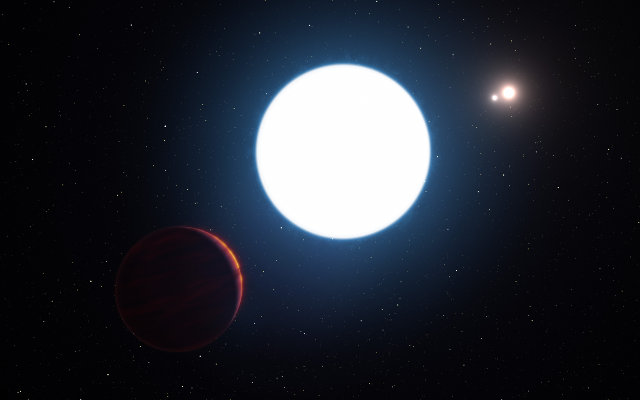
Artistic representation of the HD 131399 system with its exoplanet and its three stars (Image ESO/L. Calçada)

An article published in the journal “Science” describes the discovery of the exoplanet HD 131399Ab, the first ever found in a system with three suns. A team of astronomers led by the University of Arizona used the SPHERE instrument mounted on ESO’s VLT to obtain a direct image of HD 131399Ab and its system’s three stars. Scientists thought that such an orbit was unstable but this case seems to contradict that idea.

Jupiter seen at infrareds with VLT (Image ESO/L. Fletcher)

At the UK’s Royal Astronomical Society’s National Astronomy Meeting being held in Nottingham new images of the planet Jupiter were presented, obtained with the infrared VISIR instrument installed on ESO’s VLT. They will help better understand Jupiter’s atmosphere on the occasion of the arrival of NASA’s Juno space probe, scheduled for July 4, 2016.