ESO

The central part of the Milky Way (Image ESO/VVV Survey/D. Minniti)

An article published in “The Astrophysical Journal Letters” describes the discovery of the relics of an ancient globular cluster in the Milky Way’s central area. A team of astronomers led by Dante Minniti (Universidad Andrés Bello, Santiago, Chile) and Rodrigo Contreras Ramos (Instituto Milenio de Astrofísica, Santiago, Chile) used observations from the “Variables in the Via Lactea with VISTA” (VVV) survey carried out with ESO’s VISTA telescope to discover the ancient stars of type RR Lyrae for the first time in that area.

Galaxies rich in carbon monoxide seen in orange together with the ones seen by Hubble in blue (Image B. Saxton (NRAO/AUI/NSF); ALMA (ESO/NAOJ/NRAO); NASA/ESA Hubble)

A series of articles to be published in “Astrophysical Journal” and “Monthly Notices of the Royal Astronomical Society” describe different parts of a research based on the observation of the Hubble Space Telescope’s Ultra Deep Field (HUDF) using the radio telescope ALMA. These observations show that the rate of star formation in young galaxies is closely related to their total mass in stars.

Artistic concept of Proxima b's surface. In the upper-right of Proxima Centauri there are Alpha Centauri A and B (Image ESO/M. Kornmesser)

Yesterday ESO held a press conference to announce that probably they discovered an exoplanet orbiting Proxima Centauri, the nearest star to the solar system. A team of astronomers led by Guillem Anglada-Escudé from Queen Mary University of London found what was called Proxima b, a planet a little more massive than the Earth orbiting in the habitable zone of its star.

Artistic concept of the V883 Orionis system with its protoplanetary disc and the snow in it (Image A. Angelich (NRAO/AUI/NSF)/ALMA (ESO/NAOJ/NRAO))

An article published in the journal “Nature” describes the first observation ever of the water snow line in the V883 Orionis system. Using the ALMA radio telescope, a team led by Lucas Cieza of the Universidad Diego Portales, Santiago, Chile, identified the distance from the star beyond which the temperature drops enough for water to freeze.

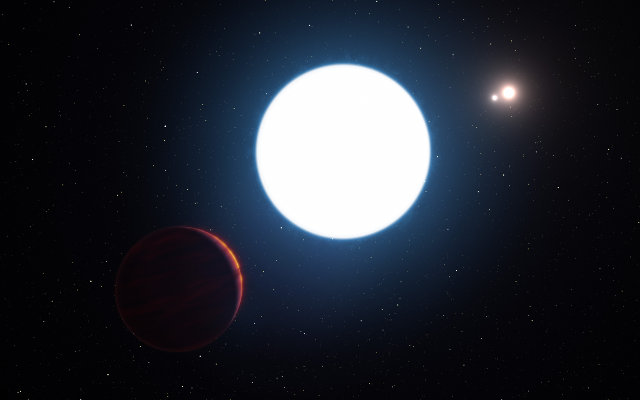
Artistic representation of the HD 131399 system with its exoplanet and its three stars (Image ESO/L. Calçada)

An article published in the journal “Science” describes the discovery of the exoplanet HD 131399Ab, the first ever found in a system with three suns. A team of astronomers led by the University of Arizona used the SPHERE instrument mounted on ESO’s VLT to obtain a direct image of HD 131399Ab and its system’s three stars. Scientists thought that such an orbit was unstable but this case seems to contradict that idea.