ESO

The RCW 38 cluster in infrared light (Image ESO/VVVX survey)

ESO has released images of the stellar nursery cataloged as RCW 38, obtained using the VISTA InfraRed CAMera (VIRCAM) mounted on its Visible and Infrared Survey Telescope for Astronomy (VISTA) in Chile. It was obtained as part of the VISTA Variables in the Vía Láctea (VVV) astronomical survey, which produced the most detailed infrared map of the Milky Way. The infrared observations allow to see the electromagnetic emissions generated by young stars and protostars within RCW 38, which can pass through the blanket of gas and dust that blocks almost all other electromagnetic bands.

The WOH G64 star seen from the VLTI (ESO Image/K. Ohnaka et al.)

An article published in the journal “Astronomy & Astrophysics” reports the creation of a detailed image of the red supergiant star WOH G64 and its surroundings, the first ever obtained of a star outside the Milky Way. A team of researchers led by astrophysicist Keiichi Ohnaka of the Universidad Andrés Bello, Chile, used the GRAVITY instrument on ESO’s VLTI in Chile to obtain details of this star in the Large Magellanic Cloud. This study may provide important insights into a star that is going through the death throes that will end with its explosion as a supernova. A dust cocoon and a possible torus surrounding WOH G64 show signs of that death throes.

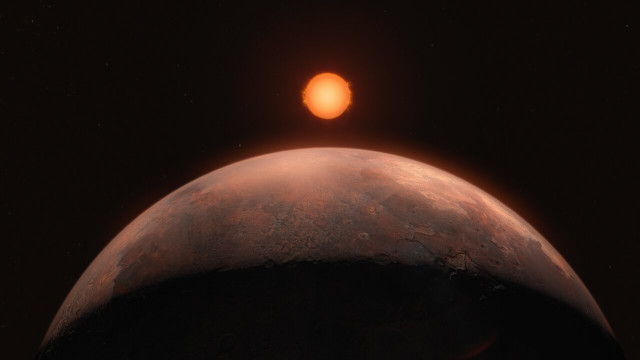
Artist’s impression of the exoplanet Barnard b with Barnard's Star in the background (Image ESO/M. Kornmesser)

An article published in the journal “Astronomy & Astrophysics” reports the identification of an exoplanet smaller than Earth orbiting Barnard’s Star. A team of researchers identified the exoplanet designated as Barnard b using the ESPRESSO instrument installed on ESO’s VLT in Chile. This discovery was later confirmed with other specialized exoplanet-hunting instruments: HARPS, HARPS-N, and CARMENES. The researchers also detected other signatures that suggest the presence of three exoplanet candidates, but follow-up investigations are needed to verify their existence.

The nebula NGC 6164/6165 surrounding the system HD 148937 as seen by the VLT Survey Telescope (Image ESO/VPHAS+ team. Acknowledgment: CASU)

An article published in the journal “Science” reports a study on the HD 148937 system, a binary system surrounded by a double nebula known as NGC 6164/6165. A team of researchers used the PIONIER and GRAVITY instruments mounted on ESO’s VLT Interferometer (VLTI) in Chile and archival data from the FEROS instrument at the La Silla Observatory, also an ESO’s telescope in Chile, to collect the data necessary to conclude that it was originally at least a triple system and at some point two of the stars merged. It was a violent event that created the cloud of materials around the system.

Some of the systems observed with the VLT and represented here not in scale to appear similar in size

Three articles published in the journal “Astronomy & Astrophysics” report different aspects of a large study of 86 protoplanetary disks located in three different regions of the Milky Way. Teams of researchers with several shared members used the SPHERE instrument mounted on ESO’s Very Large Telescope (VLT) in Chile as part of the GTO and DESTINYS observation programs. The findings offer a treasure trove of information about planetary formation in the cosmic neighborhood that could lead to advances in current models and aid follow-up studies.