ESO

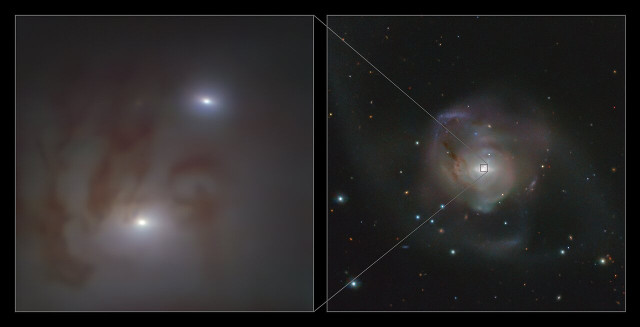
The galaxy NGC 7727 and its pair of supermassive black holes seen by the VLT

An article published in the journal “Astronomy & Astrophysics” reports the detection of a pair of supermassive black holes in the galaxy NGC 7727. A team of researchers used ESO’s VLT to conduct the observations that led to a discovery that broke two records in this field. The two supermassive black holes are the closest pair discovered so far at about 89 million light-years from Earth and are the closest to each other, as their distance was estimated to be around 1,600 light-years.

The galaxies NGC 1300, and NGC 1087, NGC 3627 (top), NGC 4254 and NGC 4303 (bottom)

ESO has published some images created during the PHANGS project using the MUSE instrument on the VLT. These are images of galaxies in the nearby universe in which researchers from the PHANGS project tried to identify stellar nurseries. The aim is to get answers to the questions that still exist about star formation. For this reason, the investigation conducted with the MUSE instrument is a part of a larger project that includes other parallel investigations conducted with the ALMA radio telescope and the Hubble Space Telescope.

The SU Aurigae system (Image ESO/Ginski et al.)

An article published in “The Astrophysical Journal Letters” reports a research on the very young star SU Aurigae, or simply SU Aur, and on the protoplanetary disk around it. A team of researchers used new observations conducted with the SPHERE instrument on the VLT, combining them with old observations conducted with the NaCo instrument, also on the VLT, with the Hubble Space Telescope, and with the ALMA radio telescope to study the disk. It has a sort of tail of dust that comes from a nebula that is probably the result of a collision between the star and a cloud of gas and dust.

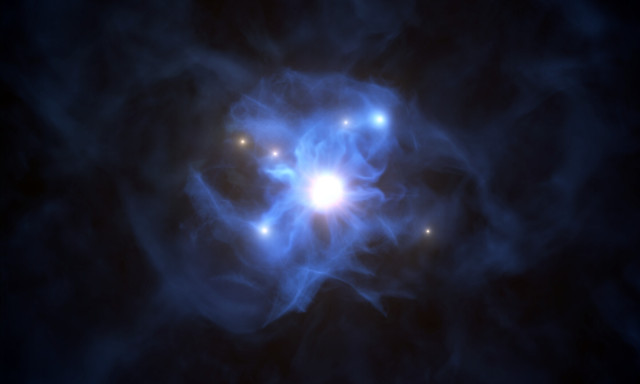
Artist's concept of a supermassive black hole surrounded by galaxies within a cosmic web (Image ESO/L. Calçada)

An article published in the journal “Astronomy & Astrophysics Letters” reports a study on a group of six galaxies surrounding a supermassive black hole which date back to an early epoch when the universe was less than a billion years old. A team of researchers led by Marco Mignoli of the Italian National Institute of Astrophysics (INAF), Bologna, used ESO’s Very Large Telescope (VLT) and the Large Binocular Telescope (LBT) to observe that structure which turned out to be complex as it includes filaments of matter that extend for a distance over 300 times the size of the Milky Way. The gas that concentrates in that structure forms what have been likened to the threads of a spider’s web, and that gas could be responsible for the development of a supermassive black hole in such a remote time.

The galaxy NGC 1365 seen by MUSE (Image ESO/TIMER survey)

ESO has published an image of the galaxy NGC 1365, also known as The Great Barred Spiral Galaxy, captured with the MUSE instrument mounted on the VLT in Chile. The nickname is due to its particular shape with two structures running from its center that extend to its borders. It’s an uncommon type of galaxy since about 15% of galaxies belong to it while spiral ones are common. In this case, there’s a second bar inside the main one. The observations conducted with MUSE will help to understand the dynamics of the stars within NGC 1365 and its supermassive black hole.