
ESO

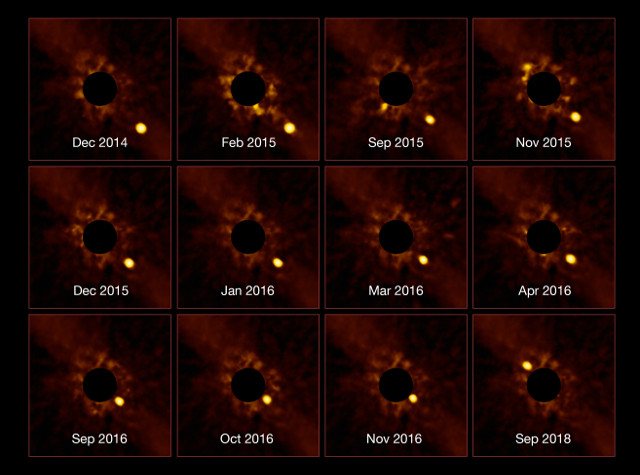
Beta Pictoris b (Image ESO/Lagrange/SPHERE consortium)

ESO has published a time-laps composition of images showing the exoplanet Beta Pictoris b while orbiting its star. It was discovered in 2008 using the NACO instrument mounted on the VLT in Chile and the team led by Dr. Anne-Marie Lagrange who discovered it kept on studying it some years later using the SPHERE instrument, which in the meantime was also mounted on the VLT. The researchers lost sight of it when it approached its star’s halo too closely to be resolved by any current instrument but got visible again in September 2018.

Simulation of materials near Sagittarius A* (Image ESO/Gravity Consortium/L. Calçada)

An article published in the journal “Astronomy & Astrophysics” describes the detection of very hot gas clouds that orbit the supermassive black hole at the center of the Milky Way, called Sagittarius A* or simply SgrA*. A team of researchers used the GRAVITY instrument installed on ESO’s VLT to observe infrared light flares coming from the gas and dust accretion disk that orbits SgrA* at very high speed. These are the most accurate observations of materials so close to a black hole’s event horizon.

NGC 2467 seen by FORS2 (Image ESO)

ESO has published a photo of the nebula NGC 2467, also known as the Skull Nebula, taken using the FORS2 instrument mounted on the VLT in Chile. It’s a stellar nursery as it contains a lot of gas that’s still forming a number of new stars and consequently sees a predominance of young, often massive, stars. The photo was taken as part of ESO’s Cosmic Gems programme, which has also an educational purpose.

The Hyperion proto-supercluster (Image ESO/L. Calçada & Olga Cucciati et al.)

An article published in the journal “Astronomy & Astrophysics” describes the discovery of a huge galaxy proto-supercluster with a mass close to that of the largest existing structures in the recent universe. A team led by Olga Cucciati of the Italian Institute for Astrophysics, Bologna discovered it thanks to the data collected by the VUDS (VIMOSUltra-Deep Survey) project and named it Hyperion after the titan because it’s really titanic. the researchers estimated that this structure dates back about 2.3 billion years after the Big Bang, the largest and most massive discovered dating back to such a remote era with a mass estimated at over a million billion times the Sun’s.

The sky around NGC 5018

An article accepted for publication in “The Astrophysical Journal” describes the VST Early-type GAlaxy Survey (VEGAS). A team of researchers led by Marilena Spavone from INAF-Astronomical Observatory of Capodimonte in Naples, Italy, used ESO’s VLT Survey Telescope (VST) in Chile to obtain highly detailed images of many elliptical galaxies. Among them there’s NGC 5018, interesting among other things for structures such as what’s called a tidal tail, a stream of gas containing various stars stretching outwards from that galaxy. These are evidence of interactions between galaxies that provide information on the characteristics of primordial galaxies.