Galaxies

International Gemini Observatory/NOIRLab/NSF/AURA/P. Marenfeld QuasarPōniuāena

An article published in “The Astrophysical Journal Letters” reports the discovery of the most distant cold molecular gas in the interstellar medium of the galaxy that hosts the quasar nicknamed Pōniuāʻena, one of the three most distant bright quasars known. A team of researchers led by some associates of the Italian National Institute of Astrophysics (INAF) used observations conducted with the NOEMA (Northern Extended Millimeter Array) radio telescope to obtain the detection of the gas, to be precise carbon monoxide. This study can provide valuable information to understand how a supermassive black hole could have a mass 1.5 billion times the Sun’s when the universe was “only” 700 million years old.

On the left, the galaxy cluster WHL0137-08 and in the inset, the galaxy nicknamed the Sunrise Arc in its distorted form, which hosts the star Earendel

Two articles, one published in “The Astrophysical Journal” and one in “The Astrophysical Journal Letters”, report various aspects of a study of Earendel, the most distant single known star. Two teams of researchers with several members in common used observations conducted with the James Webb Space Telescope to obtain new details of this star, which even such a powerful instrument could only detect thanks to a gravitational lens. Officially cataloged as WHL0137-LS, the new study turns out to be a class B blue giant, much more massive than the Sun. Webb’s observations also reveal a luminous component that could belong to a less massive companion and not even the Hubble Space Telescope was able to detect.

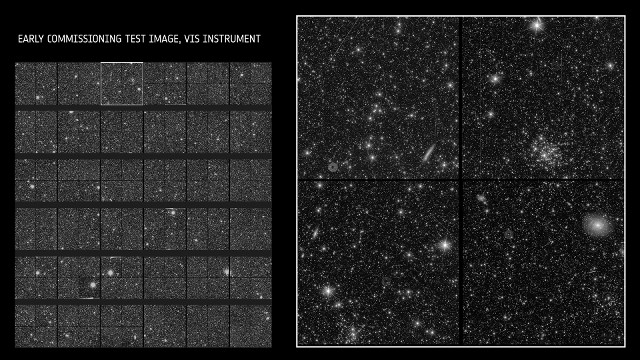
Early commissioning test image – VIS instrument full field of view and zoom in for detail

ESA has published the first test images captured by the Euclid Space Telescope. As soon as Euclid reached its destination, testing of both instruments, VIS and NISP, began and will continue for a couple of months to calibrate them until they reach optimal performance. They are necessary tasks to enable Euclid to conduct the scientific mission which consists of investigating the dark universe to try to solve some cosmological mysteries such as that of the acceleration of the universe expansion.

The so-called ultradeep field used in the MIDIS survey and on the right, some of the primordial galaxies at the center of this study are highlighted in the circle

An article published in “The Astrophysical Journal Letters” reports a study indicating that the early universe was much brighter than predicted by simulations based on current cosmological models. A team of researchers coordinated by the Center for Astrobiology (CAB) in Madrid, Spain, used observations conducted with the James Webb Space Telescope to examine galaxies that formed between 200 and 500 million years after the Big Bang. The combination of observations conducted with the NIRCam instrument and the MIRI Deep Imaging Survey (MIDIS) of the Hubble Ultra Deep Field (HUDF) on a sample of 44 primordial galaxies shows their surprising brightness and compactness.

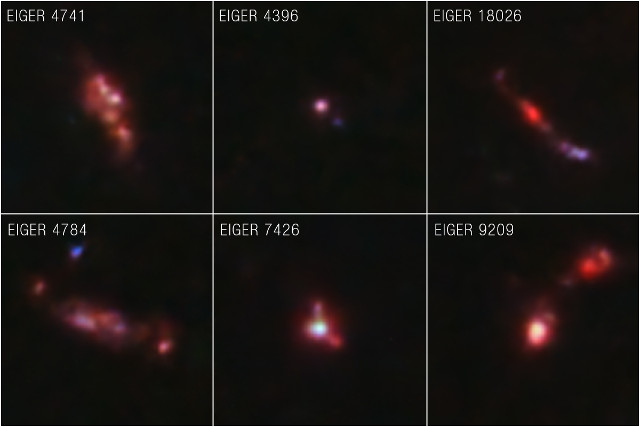
Some galaxies observed in this study, which we see as they were when the universe was 900 million years old

Three articles published in “The Astrophysical Journal” report various aspects of a study on the epoch of reionization and bring evidence that the first galaxies transformed the universe from an opaque place to the current place where light can spread. Researchers from the EIGER team led by Simon Lilly of the ETH Zurich, Switzerland, used the James Webb Space Telescope together with some ground-based telescopes to observe primordial galaxies finding transparent regions around them thanks to the reionization of the gas.