
Galaxies

galaxy UHZ1 as seen by the Chandra X-ray Observatory and the James Webb Space Telescope

An article published in the journal “Nature Astronomy”, one published in “The Astrophysical Journal Letters”, and one submitted for publication in “The Astrophysical Journal” report different aspects of the study of the most distant black hole detected at X-rays. Different teams of researchers combined data obtained with the Chandra X-ray Observatory and the James Webb Space Telescope to study the galaxy UHZ1 in X-ray and infrared light. The result is the discovery of a growing supermassive black hole approximately 470 million years after the Big Bang. The study offers evidence that it was born already having considerable mass, confirming that supermassive black holes grow from seeds that form from the direct collapse of enormous amounts of gas.

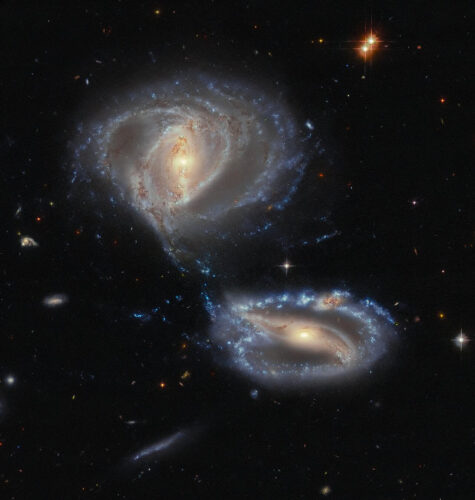
Arp-Madore 2339-661 (Image ESA/Hubble & NASA, J. Dalcanton, Dark Energy Survey/DOE/FNAL/NOIRLab/NSF/AURA Acknowledgement: L. Shatz)

An image captured by the Hubble Space Telescope depicts Arp-Madore 2339-661, an object that until not many years ago was considered a pair of interacting galaxies, cataloged as NGC 7733 (bottom right) and NGC 7734 (top left). However, observing the upper arm of NGC 7733, it’s possible to see a sort of large knot of a color different from the predominant blue which is actually a dwarf galaxy, now cataloged as NGC 7733N. The consequence is that the interaction taking place is what some call a merging group. Mergers between two galaxies are normal but sometimes there are more galaxies and in this case, there are three of them that show signs of having active galactic nuclei.

Arp 107 (Image ESA/Hubble & NASA, J. Dalcanton)

An image captured by the Hubble Space Telescope shows Arp 107, a pair of interacting galaxies heading towards a collision. The two galaxies, the spiral galaxy UGC 5984 (or PGC 32620) and the elliptical galaxy MCG +05-26-025 (or PGC 32628), will finish this process in a merger. UGC 5984 is a Seyfert galaxy, a class characterized by an active galactic nucleus that doesn’t block the view of the rest of the galaxy and spectral lines that show a strong ionization. The pair represents an interesting case of the early phase of a galaxy merger.

A diagram illustrating the combined power of the James Webb and Hubble space telescopes in studying Cepheids present in the galaxy NGC 5584 with the NIRCam (Near-Infrared Camera) and WFC3 (Wide Field Camera 3) instruments, respectively

An article accepted for publication in “The Astrophysical Journal” reports the results of calculating the universe’s expansion rate based on the observation of Cepheids with the James Webb Space Telescope. In particular, a team of researchers led by Adam Riess used the NIRCam instrument to observe over 330 cepheids in the galaxies NGC 4258 and NGC 5584. The results are more precise than those obtained in the past with the Hubble Space Telescope but confirm the accuracy of the previous calculation of the universe’s expansion rate. This leaves open the question of the difference in results obtained with different methods.

International Gemini Observatory/NOIRLab/NSF/AURA/P. Marenfeld QuasarPōniuāena

An article published in “The Astrophysical Journal Letters” reports the discovery of the most distant cold molecular gas in the interstellar medium of the galaxy that hosts the quasar nicknamed Pōniuāʻena, one of the three most distant bright quasars known. A team of researchers led by some associates of the Italian National Institute of Astrophysics (INAF) used observations conducted with the NOEMA (Northern Extended Millimeter Array) radio telescope to obtain the detection of the gas, to be precise carbon monoxide. This study can provide valuable information to understand how a supermassive black hole could have a mass 1.5 billion times the Sun’s when the universe was “only” 700 million years old.