Galaxies

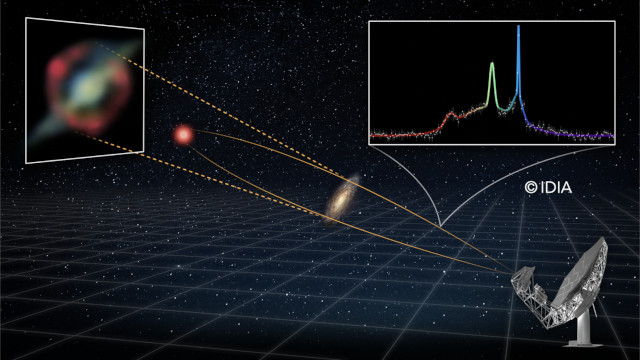
An illustration of the emission detected from the galaxy HATLAS J142935.3–002836

An article accepted for publication in the journal “Monthly Notices of the Royal Astronomical Society Letters” reports the detection of a megamaser generated by HATLAS J142935.3–002836, a galaxy undergoing considerable activity due to a galaxy merger that also led to an intense star formation. A team of researchers led by the University of Pretoria, South Africa, used the MeerKAT radio telescope to detect the maser emissions. The strength of its emissions is so high that the researchers called it a gigamaser, but certain detections are only possible thanks to a gravitational lensing phenomenon. This still makes it the brightest and most distant astronomical maser known.

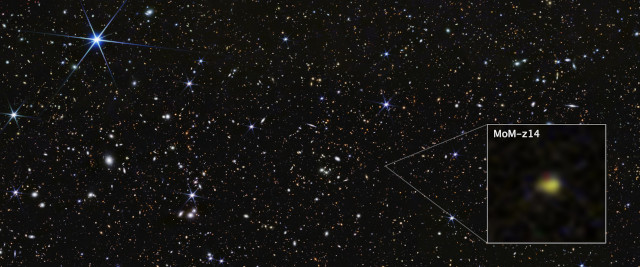
The galaxy MoM-z14 photographed by the James Webb Space Telescope's NIRCam (Near-Infrared Camera) instrument with an image from the so-called COSMOS Legacy Field in the background.

An article accepted for publication in the “Open Journal of Astrophysics” reports evidence that the galaxy MoM-z14 is the most distant known so far. A team of researchers led by the Kavli Institute for Astrophysics and Space Research at the Massachusetts Institute of Technology (MIT) used the James Webb Space Telescope as part of the “Mirage or Miracle” (MoM) survey, in which the NIRSpec instrument was used to verify the nature of very bright and potentially very distant galaxies observed in images captured by the NIRCam instrument. The results confirm that we see MoM-z14 as it was about 280 million years after the Big Bang, confirming again that highly active galaxies existed at that time.

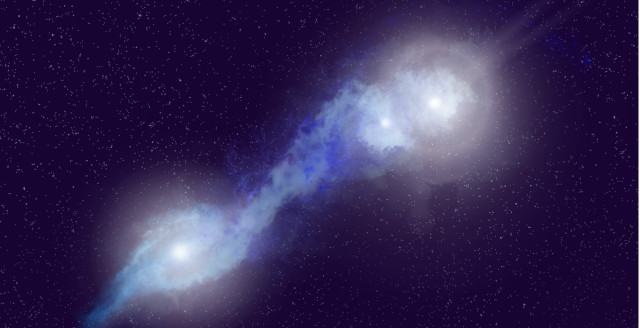
Artist's impression of the J1218/1219+1035 system (Image NSF/AUI/NSF NRAO/P. Vosteen)

A rare example of three active galactic nuclei in three merging galaxies has been discovered using two radio telescopes: the VLA and the VLBA. The triple system, approximately 1.2 billion light-years from Earth, is cataloged as J1218/1219+1035. This targeted study, conducted by a team of researchers at various radio frequencies, has identified only the third case of a triple active galactic nucleus, the first confirmed through radio observations. This discovery is useful for better understanding certain galaxy merger processes, such as the ones that led to the formation of the Milky Way.

The complete map obtained thanks to the SPHEREx space telescope, with infrared emissions generated mainly by dust (red) and hot gas (blue), key ingredients in the formation of new stars and planets

NASA has published the first cosmic map generated using observations from its SPHEREx space telescope. In particular, these observations include 102 wavelengths in the near-infrared. What NASA has defined as 102 colors offer a wealth of different information about the observed objects, valuable in a variety of cosmological studies. The wealth of information is such that NASA treats them as if they had obtained 102 different maps.

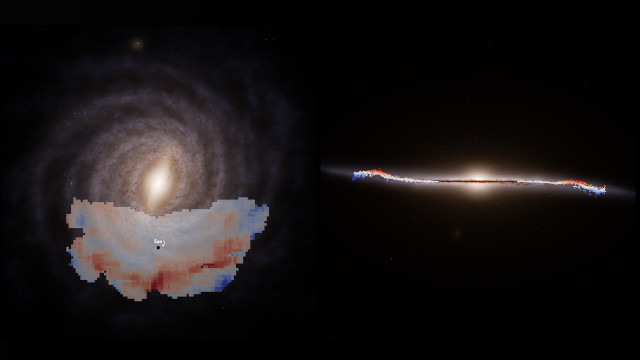
The cosmic wave in red and blue, with stars above the galactic disk in red and the ones below it in blue

An article published in the journal “Astronomy and Astrophysics” reports the results of a study that provides evidence that a sort of giant cosmic wave is crossing the Milky Way, propagating from the center outward from the galactic disk, causing a corrugation. A team of researchers led by Eloisa Poggio of the Italian National Institute for Astrophysics used data collected by ESA’s Gaia space probe to map the motions of thousands of young giant stars and Cepheids within the corrugation, reconstructing the wave that generates them. The cause may be the aftermath of an ancient collision with a dwarf galaxy, but follow-up studies are needed to assess this and other possible explanations.