Galaxies

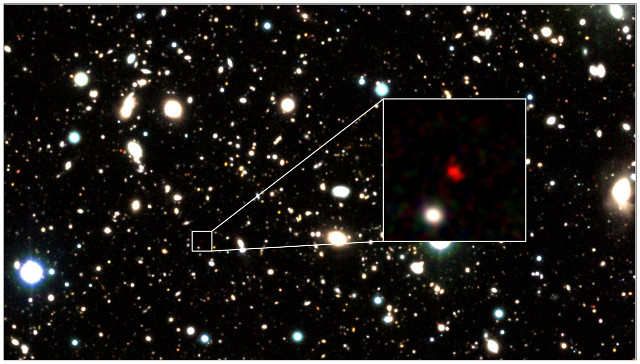
HD1 in the zoom-in image (Image courtesy Harikane et al.)

An article published in “The Astrophysical Journal” reports the discovery of what could set the new record for the most distant known galaxy. A team of researchers used various telescopes to observe this object, cataloged as HD1, whose distance has been estimated to be about 13.5 billion light-years from Earth.

In another article, published in the journal “Monthly Notices of the Royal Astronomical Society Letters”, some of the researchers offer some theories about HD1. It could be a so-called starburst galaxy with an extraordinary star formation star which could include the first generation of stars in the universe or a quasar powered by the oldest known supermassive black hole.

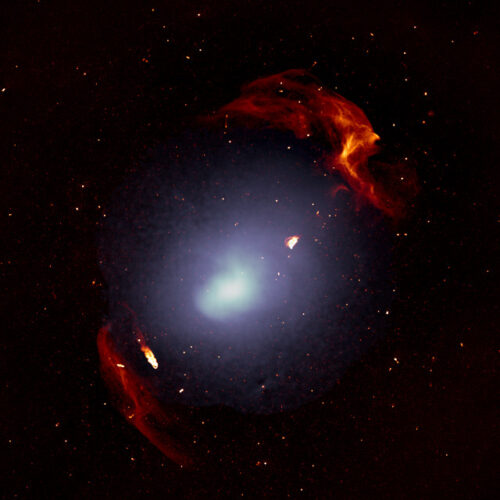
The galaxy cluster Abell 3667

An article published in the journal “Astronomy & Astrophysics” reports the most detailed view ever obtained of remains inside the galaxy cluster Abell 3667 with a shock wave that expands over about 6.5 million light-years, the largest ever identified. A team of researchers led by Francesco de Gasperin of the Italian National Institute of Astrophysics used the MeerKAT radio telescope to obtain detailed images of a shock wave generated by the collision between two galaxy clusters that occurred over a billion years ago.

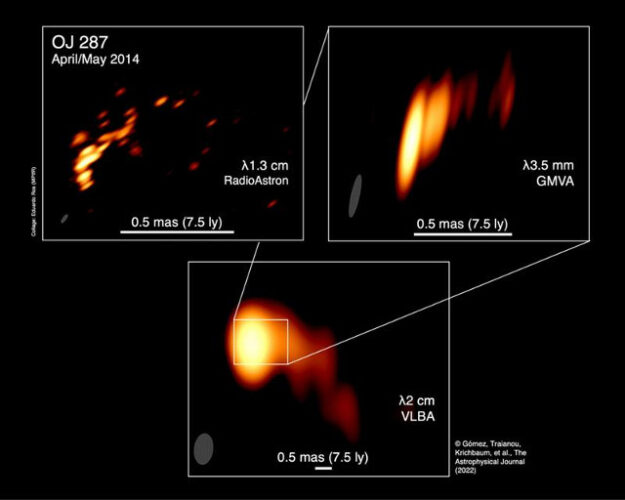
The blazar OJ 287 observed at different wavelengths by RadioAstron, GMVA, and VLBA

An article published in “The Astronomical Journal” reports observations of the blazar OJ 287 conducted by combining different radio telescopes in various areas of the world and the RadioAstron antenna in space. A team of researchers obtained in this way the highest resolution images obtained so far of OJ 287. They confirm the presence of two supermassive black holes powering the active galactic nucleus, one of the reasons why this blazar has been the focus of many scientists’ interest for a long time.

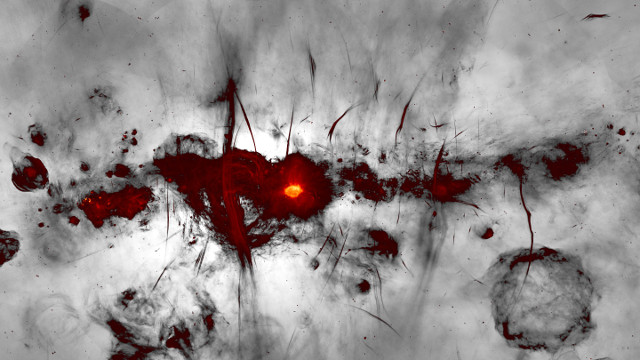
The Milky Way center as seen by MeerKAT

Two articles accepted for publication, one in “The Astrophysical Journal” and one in “The Astrophysical Journal Letters”, report different aspects of a study on the Milky Way’s center. A team of researchers used the MeerKAT radio telescope to examine the galactic center with a clarity and depth never obtained before. This made it possible to obtain new information on radio bubbles, supernova remnants, star nurseries, the region around the supermassive black hole at the center of the Milky Way, and many radio filaments.

The Andromeda galaxy (M31) with the cluster B023-G078

An article published in “The Astrophysical Journal” reports the discovery of a rare intermediate-mass black hole in the Andromeda galaxy at the center of what could be a stripped nucleus, what remains of a galaxy swallowed by Andromeda. A team of researchers observed the star cluster cataloged as B023-G078 at the Gemini Observatory and with the Hubble Space Telescope to calculate the mass distribution within it, a crucial step to understand its nature as a stripped nucleus and identify the intermediate-mass black hole. This could be a way to discover this rare type of black hole, which some models claim merges with others to form supermassive black holes following galaxy mergers.