Galaxies

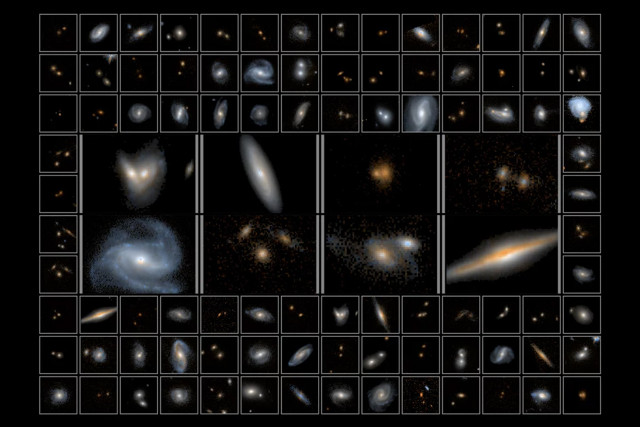
Some of the galaxies observed in the 3D-DASH survey

An article accepted for publication in “The Astrophysical Journal” reports the release of the results of the 3D-DASH survey, which aims to map star-forming regions to understand the formation of the most ancient galaxies, which from the Earth’s point of view are the most distant. A team of researchers used the Hubble Space Telescope to capture near-infrared images in the area known as the COSMOS (Cosmic Evolution Survey) field, a previous survey conducted with Hubble.

The galaxies NGC 1385, NGC 1566, NGC 3344, and NGC 6503

An article published in “The Astrophysical Journal” reports the results of a study conducted on 108 galaxies containing nuclear star clusters in search of intermediate-mass black holes. A team of researchers used NASA’s Chandra X-ray Observatory to look for the traces of this type of black hole that has so far been very elusive. In 29 of these galaxies, they found emissions they believe came from this type of black hole and traces of the destruction of thousands of stars. This suggests that intermediate-mass black holes grow by devouring stars.

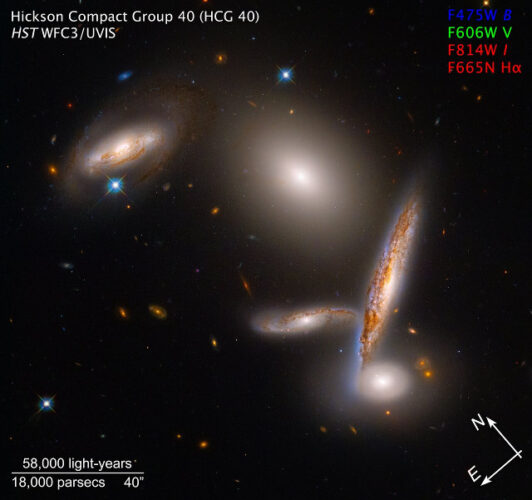
Hickson Compact Group 40 (HCG 40)

April 25, 2022, will mark the 32nd anniversary of the Hubble Space Telescope’s deployment into orbit, and to celebrate it, NASA and ESA have published images of a quintet of galaxies known as Hickson Compact Group 40 (HCG 40). This group of three spiral galaxies, one elliptical galaxy, and one lenticular galaxy is interesting for a number of reasons including the fact that within about a billion years they are predicted to collide and start merging.

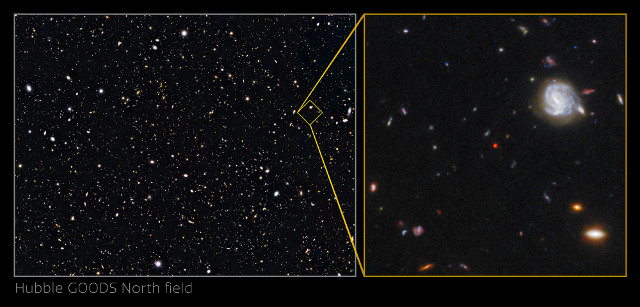
GNz7q with the likely supermassive black hole precursor in red

An article published in the journal “Nature” reports the discovery of a possible precursor of a supermassive black hole in the early universe. A team of researchers discovered the object cataloged as GNz7q in the data of the GOODS survey conducted by combining observations made with different telescopes. From Earth, we see GNz7q as it was about 750 million years after the Big Bang and its emissions can only be partially explained by a remarkable star formation. The conclusion is that there’s probably a supermassive black hole growing within the dust that fills up the primordial galaxy’s nucleus and over time it will become a quasar, a type of extremely bright active galactic nucleus.

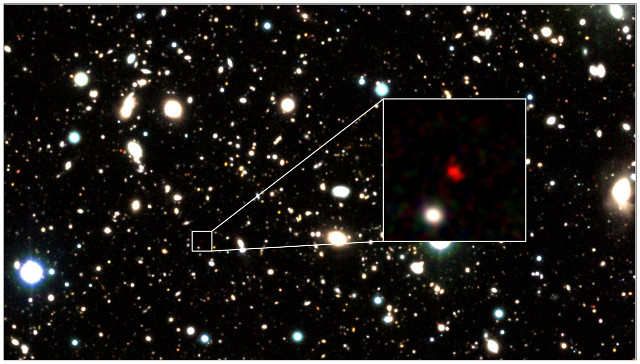
HD1 in the zoom-in image (Image courtesy Harikane et al.)

An article published in “The Astrophysical Journal” reports the discovery of what could set the new record for the most distant known galaxy. A team of researchers used various telescopes to observe this object, cataloged as HD1, whose distance has been estimated to be about 13.5 billion light-years from Earth.

In another article, published in the journal “Monthly Notices of the Royal Astronomical Society Letters”, some of the researchers offer some theories about HD1. It could be a so-called starburst galaxy with an extraordinary star formation star which could include the first generation of stars in the universe or a quasar powered by the oldest known supermassive black hole.