Galaxies

The galaxy protocluster G237

Two articles, one published in the journal “Astronomy & Astrophysics” and one in the journal “Monthly Notices of the Royal Astronomical Society”, report various aspects of the discovery of a galaxy protocluster in which there was an extraordinary rate of star formation when the universe was about 3 billion years old. A team of researchers led by Mari Polletta of the Italian National Institute of Astrophysics, Milan, found traces of the protocluster G237.01+42.50, or simply G237, in the data collected by the Planck Surveyor space probe and then used various telescopes to observe the galaxies inside it. The results were collected by a team led by Yusei Koyama of the National Astronomical Observatory, Japan.

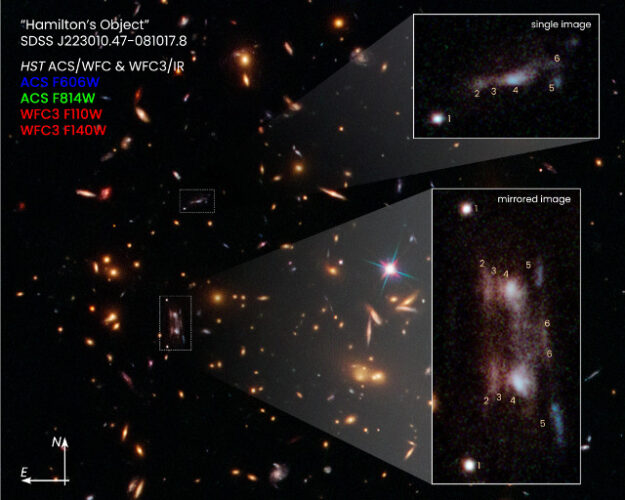
Hamilton's Object seen by Hubble

An article published in the journal “The Monthly Notices of the Royal Astronomical Society” reports a solution to an astronomical mystery involving two galaxies that appeared to be mirror images of each other and turned out to be two images of the same galaxy doubled by a gravitational lens. A team of researchers led by Richard Griffiths of the University of Hawaii at Hilo used observations made with the Hubble Space Telescope to obtain enough information to understand the nature of what was named Hamilton’s Object because it was discovered by astronomer Timothy Hamilton. Meanwhile, a third image of the galaxy was discovered, visible in another area of ​​the sky again thanks to the gravitational lens.

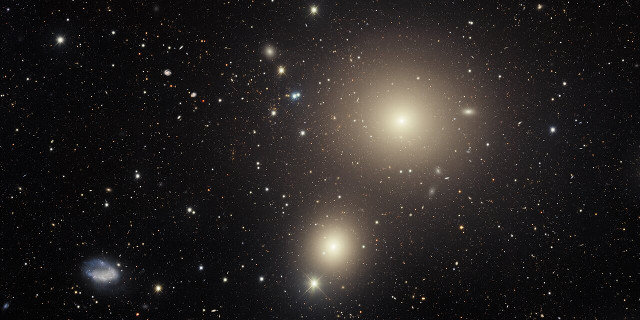
Some of the galaxies in the Fornax Cluster seen by the DECam

An image captured by the Dark Energy Camera (DECam) shows some galaxies in the Fornax Cluster. The galaxies NGC 1399 and NGC 1404 are two of the brightest in the cluster and their gravity is bringing them closer to the point that there may already be interactions. The irregular dwarf galaxy NGC 1427A, in the left corner in the top image, is suffering even more from the cluster’s gravitational pull and is moving towards its core. According to astronomers, it will eventually be destroyed in the distant future millions of years.

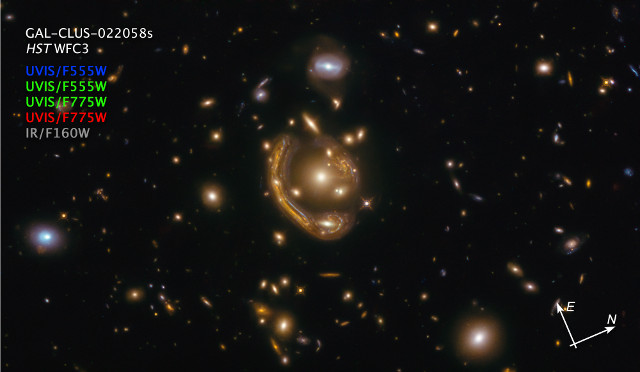
The Molten Ring seen by Hubble (Image Anastasio Díaz-Sánchez (Universidad Politécnica de Cartagena))

An article published in “The Astrophysical Journal” reports a study on the Einstein ring nicknamed the Molten Ring for its “liquid” appearance and because it was identified in the constellation of the Furnace. A team of researchers used observations made with the Hubble Space Telescope and the FORS 2 instrument on the VLT in Chile of the object formally classified as GAL-CLUS-022058s to study its physical characteristics. The ring is actually a galaxy whose light has been distorted by a gravitational lens and, according to the study’s conclusions, is about 9.4 billion light-years away from Earth.

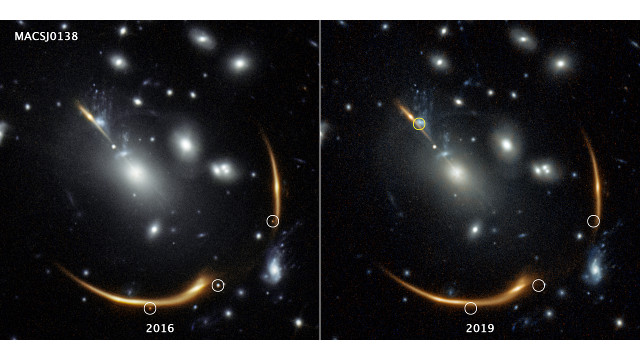
The galaxy cluster MACS J0138.0-2155 and the Requiem supernova

An article published in the journal “Nature Astronomy” reports a study on a supernova whose glow was distorted and multiplied by a gravitational lens. A team of researchers examined various images captured over the years by the Hubble Space Telescope after three images of the supernova AT 2016jka, dubbed Requiem, were discovered in 2016 archival data. As it’s normal, its brightness faded away until it disappeared but, according to the researchers, a fourth image of that supernova will be visible in 2037, again due to the distortion generated by the gravitational lens produced by the force of gravity of the galaxy cluster MACS J0138.0-2155, or simply MACS J0138.