Galaxies

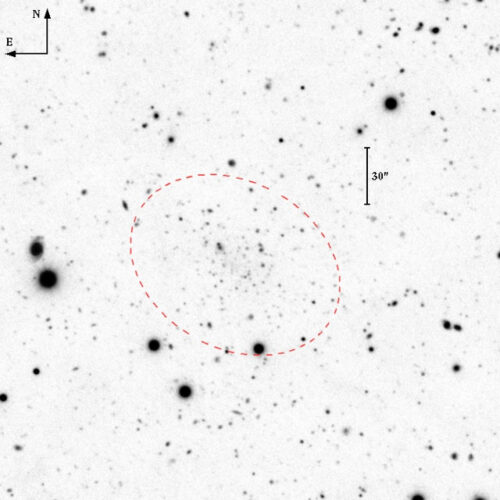
The dwarf galaxy Pisces VII seen by DOLoRes (Image courtesy W. Boschin/TNG)

An article published in the journal “Monthly Notices of the Royal Astronomical” reports the confirmation of the discovery of the dwarf galaxy Pisces VII, which could be a satellite of the Triangulum galaxy. A team of researchers led by David Martínez-Delgado of the Instituto de Astrofisica de Andalucia used the DOLoRes instrument at the Galileo National Telescope to confirm the existence of Pisces VII, originally identified by the amateur astronomer Giuseppe Donatiello. The gravitational bond with the Triangulum galaxy has yet to be verified but if the outcome were positive it would be a confirmation of the theories concerning galaxy formation, which predict the presence of various satellite galaxies. The reference is to the Lambda-CDM model, which also concerns dark matter.

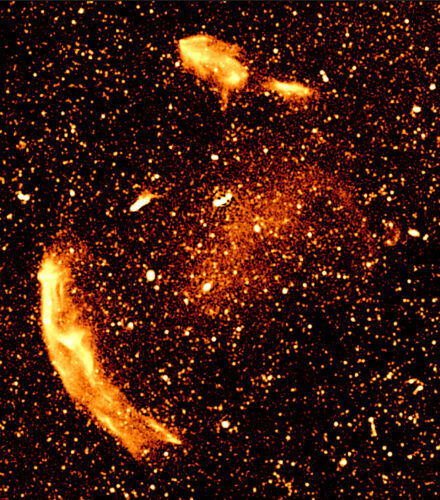
The radio tracks of a powerful merger in progress between two or more massive groups of gas and galaxies in the cluster MCXC J0352.4-7401

An article accepted for publication in the journal “Astronomy & Astrophysics” offers an overview of the results of the MGCLS (MeerKAT Galaxy Cluster Legacy Survey) project, which covers 115 galaxy clusters. A team of researchers led by Kenda Knowles of the University of KwaZulu-Natal, South Africa, used the MeerKAT radio telescope for a total of approximately 1,000 hours of observations to obtain images that were processed and analyzed. These are only the first results of an investigation that can bring new information on the processes taking place in those 115 clusters.

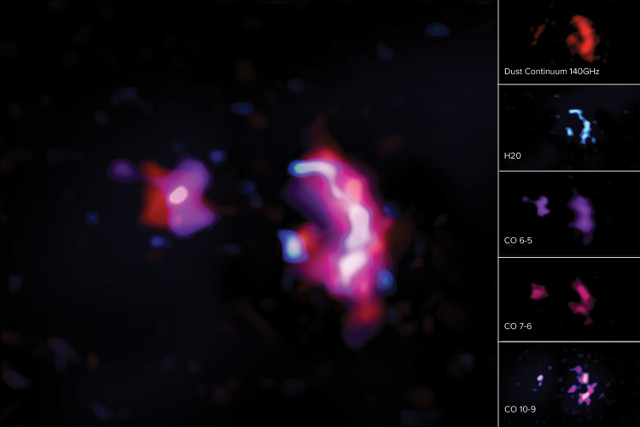
Water and carbon monoxide in the galaxy SPT0311-58 as seen by the ALMA radio telescope

Two articles, one published in “The Astrophysical Journal” and one in “Nature Astronomy”, report as many studies on molecules detected in the early universe thanks to the ALMA radio telescope. A team led by astronomer Sreevani Jarugula of the University of Illinois, USA, detected the presence of water in the galaxy SPT0311-58, about 12.88 billion light-years from Earth, the farthest ever detected in a galaxy without an active galactic nucleus. A team led by Maximilien Franco of the University of Hertfordshire, UK, detected the presence of hydrofluoric acid in the galaxy NGP–190387, about 12 billion light-years from Earth. In this case, the discovery is also important because the mechanisms of fluorine production are not very clear, and detecting their presence when the universe was about 1.4 billion years old indicates that the so-called Wolf-Rayet stars must be an important source of this element.

Three galaxies simulated in the IllustrisTNG Project

An article published in “The Astronomical Journal” reports the first results of an analysis of the data of the Data Release 3 (DR3) of the Lega-C astronomical survey, the largest spectroscopic survey of galaxies that we could define in their midlife since we see them as they were between about five and eight billion years ago. It offers information crucial to fully understand certain phases of the evolution of galaxies and star formation within them. Good news offered by a team of researchers led by Po-Feng Wu of the Institute of Astronomy and Astrophysics in Taipei (Taiwan) is the good consistency between the simulations of the IllustrisTNG program and of the observations conducted in that sort of census that was Lega-C.

The galaxy protocluster G237

Two articles, one published in the journal “Astronomy & Astrophysics” and one in the journal “Monthly Notices of the Royal Astronomical Society”, report various aspects of the discovery of a galaxy protocluster in which there was an extraordinary rate of star formation when the universe was about 3 billion years old. A team of researchers led by Mari Polletta of the Italian National Institute of Astrophysics, Milan, found traces of the protocluster G237.01+42.50, or simply G237, in the data collected by the Planck Surveyor space probe and then used various telescopes to observe the galaxies inside it. The results were collected by a team led by Yusei Koyama of the National Astronomical Observatory, Japan.