Galaxies

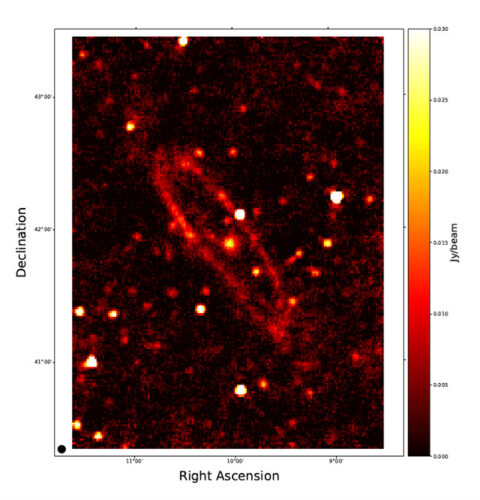
Andromeda seen from the Sardinia Radio Telescope

An article published in the journal “Astronomy & Astrophysics” reports a study on the Andromeda galaxy based on the best image captured in the microwave band. A team of researchers coordinated by Professor Elia Battistelli of the physics department at Sapienza used the Sardinia Radio Telescope (SRT) and its ability to work at high radio frequencies to create a map of Andromeda at 6.6 GHz, a frequency detected for the first time that fills a gap in the studies of the galaxy considered a sort of sister of the Milky Way. This helped to better understand the processes taking place within Andromeda identifying areas of star formation.

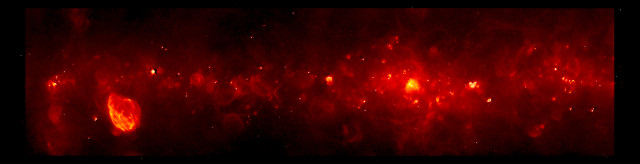
A map obtained from the GLOSTAR survey with a segment of the Milky Way disk

Four articles published in the journal “Astronomy & Astrophysics” report various aspects of the mapping of the northern galactic plane, which led, among other things, to the discovery of new areas of star formation in the Milky Way. Many researchers collaborated in the analysis of data collected within the GLOSTAR survey, which aims to examine star-forming regions within the galaxy using observations from the VLA and Effelsberg radio telescopes. The data made it possible to obtain the most detailed maps of the northern galactic plane at radio frequencies, which made it possible to identify the new star nurseries.

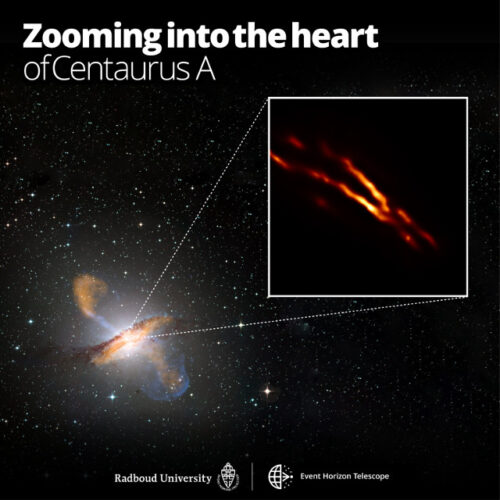
Centaurus A at high resolution in the inset superimposed on an image of the galaxy hosting the supermassive black hole

An article published in the journal “Nature Astronomy” reports observations of the jets emitted by the supermassive black hole at the center of the radio galaxy Centaurus A with details never seen before thanks to the combination of different radio telescopes. A team of researchers including the Event Horizon Telescope (EHT) collaboration used the same technique that made it possible to obtain the historical image of the area around the supermassive black hole at the center of the galaxy M87. The Centaurus A observations took place in 2017 and now the results arrived, especially the details of the jets.

The galaxies NGC 1300, and NGC 1087, NGC 3627 (top), NGC 4254 and NGC 4303 (bottom)

ESO has published some images created during the PHANGS project using the MUSE instrument on the VLT. These are images of galaxies in the nearby universe in which researchers from the PHANGS project tried to identify stellar nurseries. The aim is to get answers to the questions that still exist about star formation. For this reason, the investigation conducted with the MUSE instrument is a part of a larger project that includes other parallel investigations conducted with the ALMA radio telescope and the Hubble Space Telescope.

The galaxy NGC1052-DF2 (Image NASA, ESA, Z. Shen and P. van Dokkum (Yale University), and S. Danieli (Institute for Advanced Study))

An article published in “The Astrophysical Journal Letters” reports a precise measurement of the distance of the galaxy NGC1052-DF2 that was used to confirm that it’s almost devoid of dark matter, a notable anomaly. A team of researchers led by Pieter van Dokkum of Yale University used the Hubble Space Telescope to observe the red giants on the outskirts of NGC1052-DF2 using them as “standard candles” taking advantage of the fact that they all reach the same peak in brightness. Understanding why so few of the gravitational effects attributed to dark matter are detected in this galaxy may offer new clues to its nature.